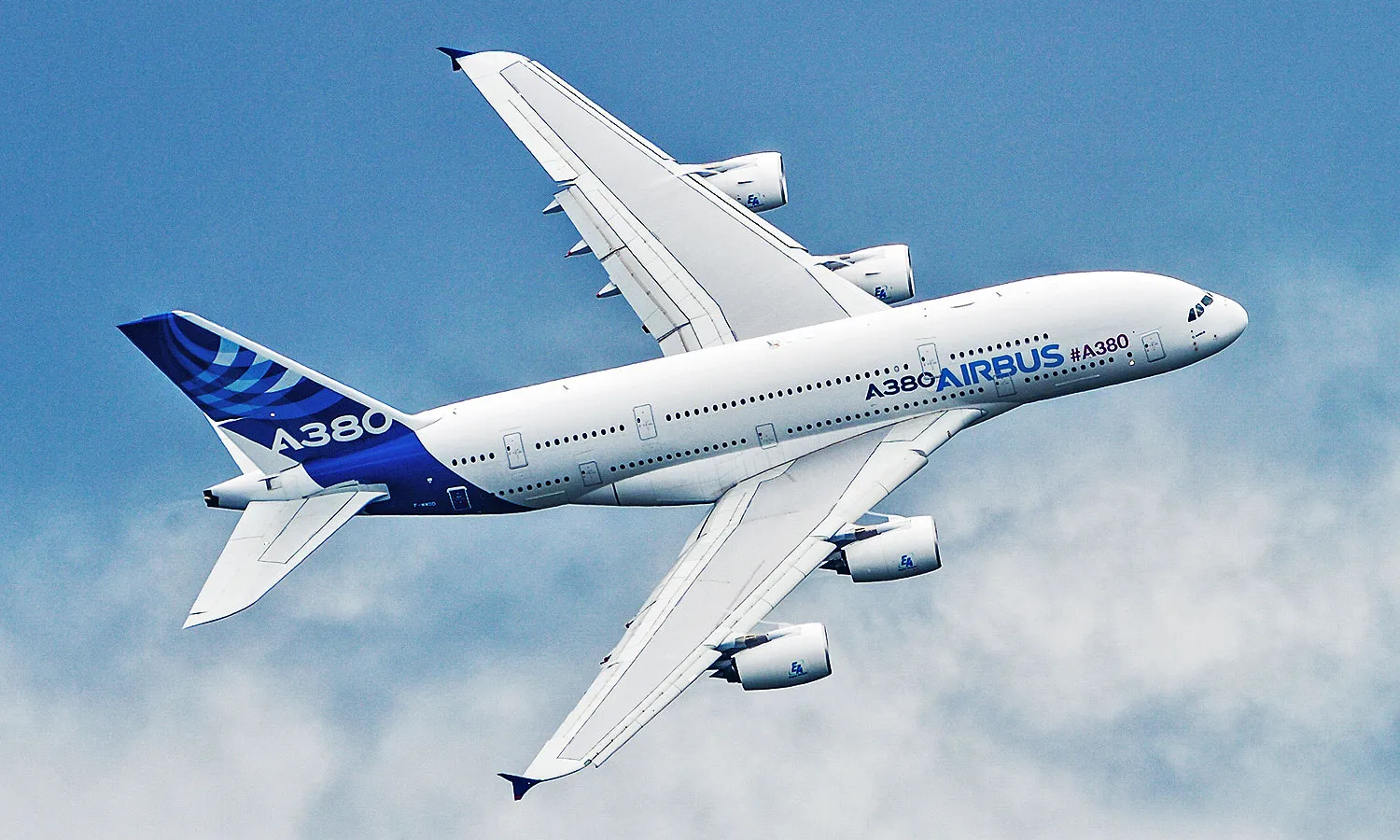
First flight of the A380, the largest passenger aircraft ever built, completes 20 years
On April 27, 2005, at 10:29 a.m., the largest commercial aircraft in the world took off from Toulouse, France, promising to revolutionize air travel: the Airbus A380.
With great expectations, the "Superjumbo" became a commercial failure for Airbus, despite its operational qualities and passenger comfort, but inadequate for the new scenario of global aviation.
The genesis of a giant
Even though there are crises, it can be said that aviation is an activity in continuous expansion. Even after the Gulf War had its knock-on effects on aviation, the outlook for the future in the 1990s was promising and the Boeing 747-400, the world’s largest commercial passenger aircraft, was unable to meet demand.
In light of this, the three main manufacturers at the time – Airbus, Boeing and McDonnell Douglas – began to study larger aircraft, all with two decks, capable of operating at the same airports served by the 747.

McDonnell Douglas offered the MD-12 in 1992, with capacity for more than 510 passengers in three classes and which was scheduled to enter into operation in 1997. However, in the mid-1990s, the company abandoned the plans and focused on enlarging the MD-11, called the MD-XX.
Boeing studied the New Large Aircraft, a double-decker aircraft with a capacity to carry 600 passengers. However, like its local rival, it abandoned the project in 1993 and returned to prioritizing studies to lengthen the Boeing 747, called the 747-500X and 747-600X. However, neither of them came to fruition.

In search of higher flights
Airbus was making its debut on long-haul flights with the A340-200 and A340-300 and wanted to go further. Launching a double-decker aircraft would be an advantage for the company’s technological capacity and an important step in the competition with Boeing for leadership in aviation.
Initially, Airbus and Boeing formed a group to develop the new aircraft, called the Very Large Commercial Transport. The effort between Americans and Europeans was motivated by market prospects: there would be demand, but not for two planemakers.
In 1994, Airbus itself began to study its own version, the Airbus A3XX. Meanwhile, Boeing withdrew from the group and began to concentrate on the 747 and 777 programs. McDonnell Douglas, already in a less favorable situation, suspended the MD-XX project in 1996 and was taken over by Boeing the following year.

Launch of the program
The program was formally launched on December 19, 2000, with a budget of US$ 10 billion, the most expensive program of the European consortium. The aircraft was named A380, the number 8 in honor of the shape of the fuselage and because it is a lucky number for Asians. The A380 was offered with two engines: Rolls-Royce Trent 900 and Engine Alliance GP7200.
The outlook seemed encouraging, with 1,235 aircraft to be sold by 2020 worldwide.

Boeing, which abandoned the project for an aircraft larger than the 747-400, shrugged its shoulders and stated that demand for this aircraft would hardly exceed 500 units and would bet on improvements to the 747 (747-400ER), 777 (777-200LR and 777-300ER) and the Sonic Cruiser, a subsonic aircraft that was nothing more than a smokescreen for the 7E7 (current 787).
The US company bet on market fragmentation, with new city-pairs instead of concentrating flights.
With a capacity for 525 passengers in three classes, the A380 promised to cost 15 to 20% less than the Boeing 747-400. A single A380 flight could practically replace two smaller aircraft and operate in markets with extremely high demand, such as Japan, which in this case would allow the A380 to reach 840 seats per flight.
The beginning seemed promising, with orders from Air France (10), Emirates (7 aircraft plus 5 options), ILFC (5), Qantas (12), Singapore Airlines (10 jets plus 15 options) and Virgin Atlantic (6 units plus 6 options).
In January 2001, it was Federal Express’ turn to announce the purchase of the A380F freighter, becoming the first cargo company to order it besides the first from the United States. The first aircraft was expected to be delivered in 2006 to Singapore Airlines, the aircraft’s launch customer.

During the production of the prototypes, the first issues arose, from incompatibility of the CATIA program between Airbus units to the realization that the aircraft would be heavier than announced. The result was two years of delays and costs rising to US$ 25 billion.
When the first flight took place, Airbus was still optimistic about the A380 program. There were 159 aircraft ordered or with purchase options and new customers: China Southern Airlines, Etihad Airways, Korean Air, Lufthansa, Malaysia Airlines, Qatar Airways, Thai Airways and UPS.
Although Airbus advertised the A380 as an ocean liner of the air, with bars, wide seats and lounge areas, the plane would essentially have a more traditional configuration, despite some customers promising amenities, such as Emirates and Singapore Airlines, due to the nature of their corporate clientele.

Start of operations
On October 15, 2007, Singapore Airlines inaugurated the first commercial flight of the A380, the SQ380 between Singapore and Sydney. The proceeds from the auction of tickets for this flight were donated to a charity. The following year, Emirates would become the second operator of the model, followed by Qantas in the same year and Air France the year after.
Both Emirates and Singapore Airlines executives praised the aircraft’s performance, with fuel economy 20% lower than that of the 747-400, and the aircraft became the talk of the town wherever it went, although not to the same extent as the 747 in the early 1970s, but it was an aircraft appreciated by passengers for its on-board comfort and by pilots for its handling.
However, the aircraft was not in line with the changes in aviation at the beginning of the 21st century, especially after September 11. Airbus saw potential customers prefer to order the Boeing 777-300ER, smaller than the A380, but with greater operational flexibility.
Operators
A total of 251 A380s were built, a number far from Airbus’s target, with the program considered to be in deficit because it did not reach break-even. Some of the manufacturer’s expectations were not met, such as operating in the congested Japanese market, in the then-growing Chinese market, in addition to adoption by European companies and cargo carriers.
One of the factors that affected the sale of the A380 was that airlines adopted a strategy of spreading flights, especially with the arrival of the 787, reducing the growth rate of super-hubs.

In addition, the A380 required a series of changes to airport infrastructure to improve its efficiency, such as wider taxiways, double boarding bridges and space compatible with its operations. Many airports did not look favorably on investing in order to receive few flights from the aircraft.
Singapore Airlines: The first operator of the A380, SIA received 24 A380s that were used on routes to Australia, Japan, the United States and Europe. It currently has 10 units in operation and intends to replace them with Boeing 777-9s.
Emirates Airlines: The largest operator of the model, with 123 units received. With an interior that meets both the capacity to carry many economy class passengers and to offer exclusive services for affluent first class passengers, the United Arab Emirates company has turned the plane into a moneymaker, to the point of lobbying Airbus to keep production or even have an improved version of the plane.
The company has several configurations, ranging from 468 seats in three classes to 615 seats in two classes for busier routes for economy class passengers, such as India.

Qantas Airways: Australia’s flag carrier has ordered 12 A380s, which are used on routes to the East Coast of the United States and London (Heathrow) via Dubai. The company will replace them with A350-1000s, which are capable of operating non-stop flights between Sydney and London.
Air France: the first European operator of the A380 in 2009, was also the first to retire the aircraft in 2020, in the wake of the COVID-19 health crisis. It flew 10 aircraft.
Lufthansa: the second European operator of the A380, Lufthansa received 14 units from 2010 onwards. Along with Korean Air, it is the only one to operate both the A380 and the 747-8, Boeing’s attempt to compete with the Superjumbo. There are eight aircraft in operation and the plan is to keep them until 2030.
China Southern Airlines: received six units from 2010 onwards and was the first to operate the A380 domestically, between Guangzhou and Beijing. However, the lack of relevance of the Guangzhou market compared to Beijing and Shanghai, the fragmentation of routes in the Chinese market and COVID-19 led the company to retire the A380s in 2022, citing high maintenance costs.
Korean Air: received 10 jets from 2011 onwards. With the purchase of Asiana Airlines, it will receive six more aircraft. The plan is to deactivate them by 2031.
Malaysia Airlines: had five A380s between 2011 and 2022, in a purchase seen more from a prestige standpoint than out of necessity, as the company had difficulty deploying the aircraft, both because it was one of the companies most affected by the rise of ME3 carriers and because of the loss of two 777-200ERs between 2013 and 2014.
Thai Airways: the Thai state-owned company followed the same path as Malaysia and operated the A380s when they were not really needed. Six aircraft flew between 2012 and 2020, when it was decommissioned due to COVID-19 and the financial situation that Thai was going through.
British Airways: the first A380 arrived in 2013 and currently has 12 in operation. The A380 proved to be an excellent aircraft to operate at the congested Heathrow airport, to the point that the company stated that it was looking for used A380s to increase supply. However, these plans have apparently been discarded.

Asiana Airlines: six aircraft were received between 2014 and 2016, which will later be transferred to Korean Air after being sold.
Etihad Airways: the Abu Dhabi airline received 10 aircraft from 2014 onwards and stood out for offering The Residence, individual cabins for first class passengers, with a living room, bedroom and private bathroom, as well as exclusive flight attendants trained by the traditional The Savoy Hotel in London.
The price of a ticket between Abu Dhabi and London cost more than US$20,000 and, during Etihad’s restructuring and the COVID-19 pandemic, it considered retiring the aircraft while they were in storage, but with the resumption of traffic, the planes returned to operation.
Qatar Airways: was the last of the ME3 carriers to fly the A380, in 2014, with 10 aircraft received. Less enthusiastic than Emirates about operating the aircraft, Qatar preferred to focus on the fleet of 777-300ERs and smaller aircraft from its hub in Doha. The aircraft will be replaced by A350-1000s in 2035.
HiFly Malta: the subsidiary of the Portuguese HiFly was the first to operate a used A380, the former 9V-SKC from Singapore Airlines. Due to tax registration, the aircraft was registered in Malta but was based at Montijo Airport, in Portugal, since Lisbon Airport did not have the structure for the aircraft. COVID-19 and the lack of charter customers meant that the company’s operations were short-lived, between 2018 and 2020.
All Nippon Airways: was the last new Airbus customer to receive the aircraft. The story is curious: commissioned by Skymark Airlines to operate on routes to London, Paris and New York, the airline became indebted and filed for bankruptcy protection.
ANA emerged as one of the candidates to buy Skymark and made an offer. Since Airbus was Skymark’s largest creditor, it made the approval of ANA’s offer conditional on receiving the A380s it had ordered. Thus, in 2019, ANA received the first A380, configured with 520 seats and dedicated to the Hawaiian market.
Global Airlines: is the newest operator of the A380, receiving an ex-China Southern aircraft in 2024 and with plans to launch flights between the United Kingdom and the United States. The aircraft will be managed by HiFly Malta.

Flexibilty rather than capacity
In addition to these operators, other airlines ordered the A380 but did not receive it, either due to cancellation (Virgin Atlantic, Federal Express, Iran Air and UPS) or due to bankruptcy (KingFischer Airlines, Skymark Airlines and Transaero).
Despite the evolution that the A380 brought to aviation, expectations that several operators would buy the aircraft were exaggerated at a time when the market was fragmented.
For this reason, the A380 program showed that the current market does not prefer capacity, but rather flexibility in its operations.
The last A380 produced was for Emirates Airlines, delivered on December 16, 2021, with registration A6-EVS. The ceremony was discreet, due to the COVID-19 lockdown period.
Designed to replace the 747, ironically the A380 was discontinued before the 747 stopped being produced.
About the Author