 Air Transport
Airbus seeks a second chance for the A350 in Brazil after earlier airline exits
Airbus believes the A350 could still find a place in the Brazilian market, despite being dropped by the country’s two largest long-haul operators in recent years. The assessment was shared by Damien Sternchuss, Airbus vice president for Latin America and the Caribbean, in comments to Brazilian newspaper O Globo.
According to Sternchuss, growth in international passenger traffic is expected to change the economics of long-haul flying in Brazil over the medium to long term. He pointed to projections indicating a sharp increase in international demand, which would eventually require aircraft with higher capacity than those currently favored by local airlines.
Brazilian carriers have so far prioritized smaller widebodies, such as the A330, as a way to limit financial exposure and manage initial operating costs when opening or rebuilding long-haul routes. Sternchuss argued that this approach makes sense in the early stages of recovery, but said larger aircraft like the A350 could become more attractive as traffic consolidates on high-density routes.
The executive’s view contrasts with the A350’s recent track record in Brazil. LATAM, which inherited an A350 order from TAM, operated 13 A350-900s between 2016 and 2021 before opting to standardize its long-haul fleet around the smaller Boeing 787, while retaining a limited number of Boeing 777-300ERs.

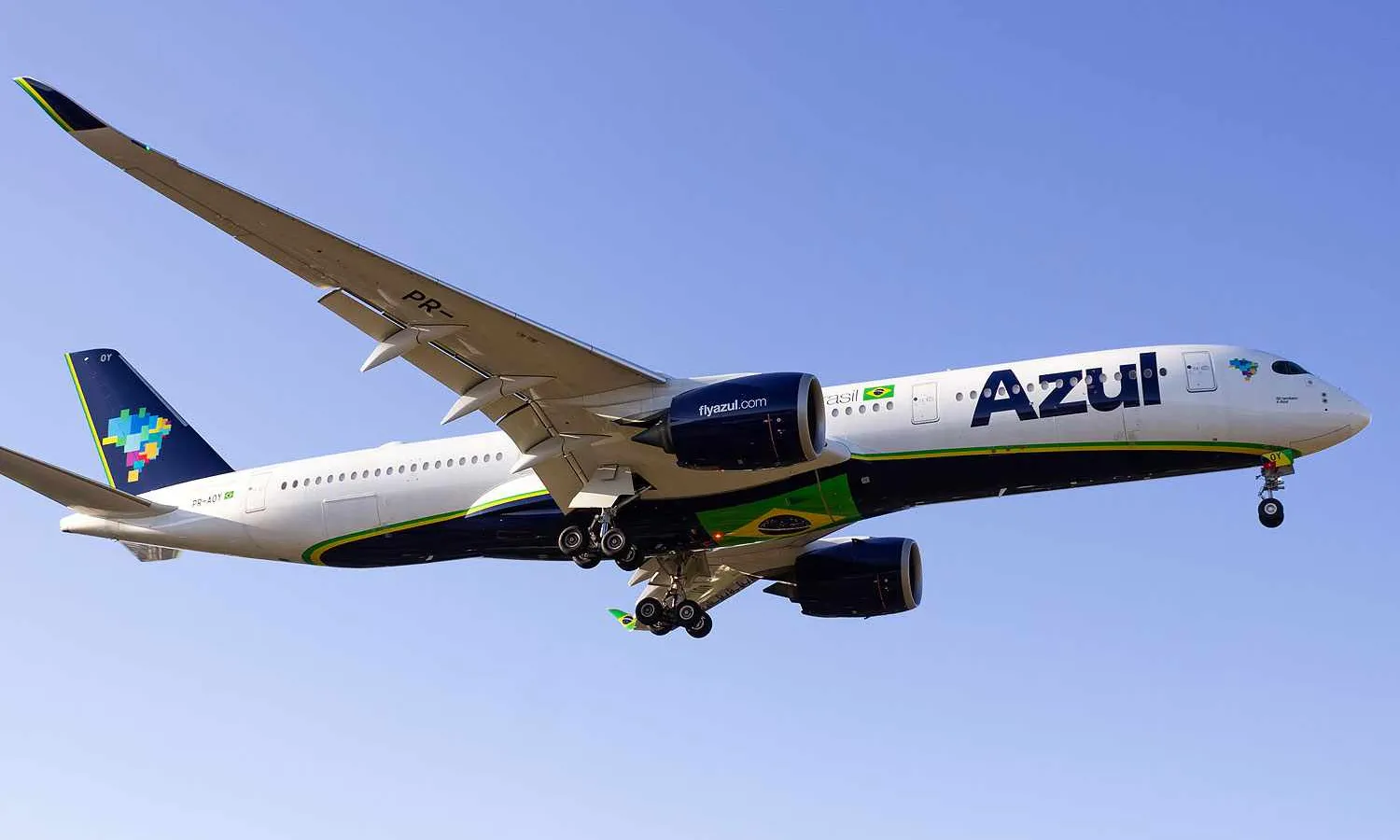
Azul also explored the type, initially planning to introduce it before switching to the A330neo, and later briefly operating two second-hand A350-900s on flights between Campinas and Paris. Those aircraft were returned after little more than a year in service.
Airbus argues that market conditions have shifted since then. International load factors among Brazilian airlines have risen to around the mid-80% range, while overall international capacity remains below pre-pandemic levels. In this context, the manufacturer sees room for higher-capacity aircraft on trunk long-haul routes, particularly as networks stabilize and frequencies increase.
With typical seating well above that of the A330, the A350 targets a different segment of the long-haul market, one that depends less on flexibility and more on sustained high demand. In Brazil, recent widebody fleet decisions have been driven primarily by route profiles, financial risk and network structure rather than headline fuel efficiency metrics.
While the A330neo has suited Azul’s point-to-point and leisure-heavy strategy, LATAM has relied on Boeing 787s and a limited number of 777-300ERs to cover its long-haul needs. Any renewed interest in the A350 would therefore hinge on the emergence of routes capable of consistently supporting higher-capacity aircraft, rather than on aircraft efficiency alone.
About the Author

Ricardo Meier
Creator of the website that started in 1996 as a magazine. He also writes on Brazilian websites AUTOO, MOTOO and MetrôCPTM.


