 Defense
Argentine Air Force Evaluates Boeing KC-135R Stratotanker for F-16 Aerial Refueling
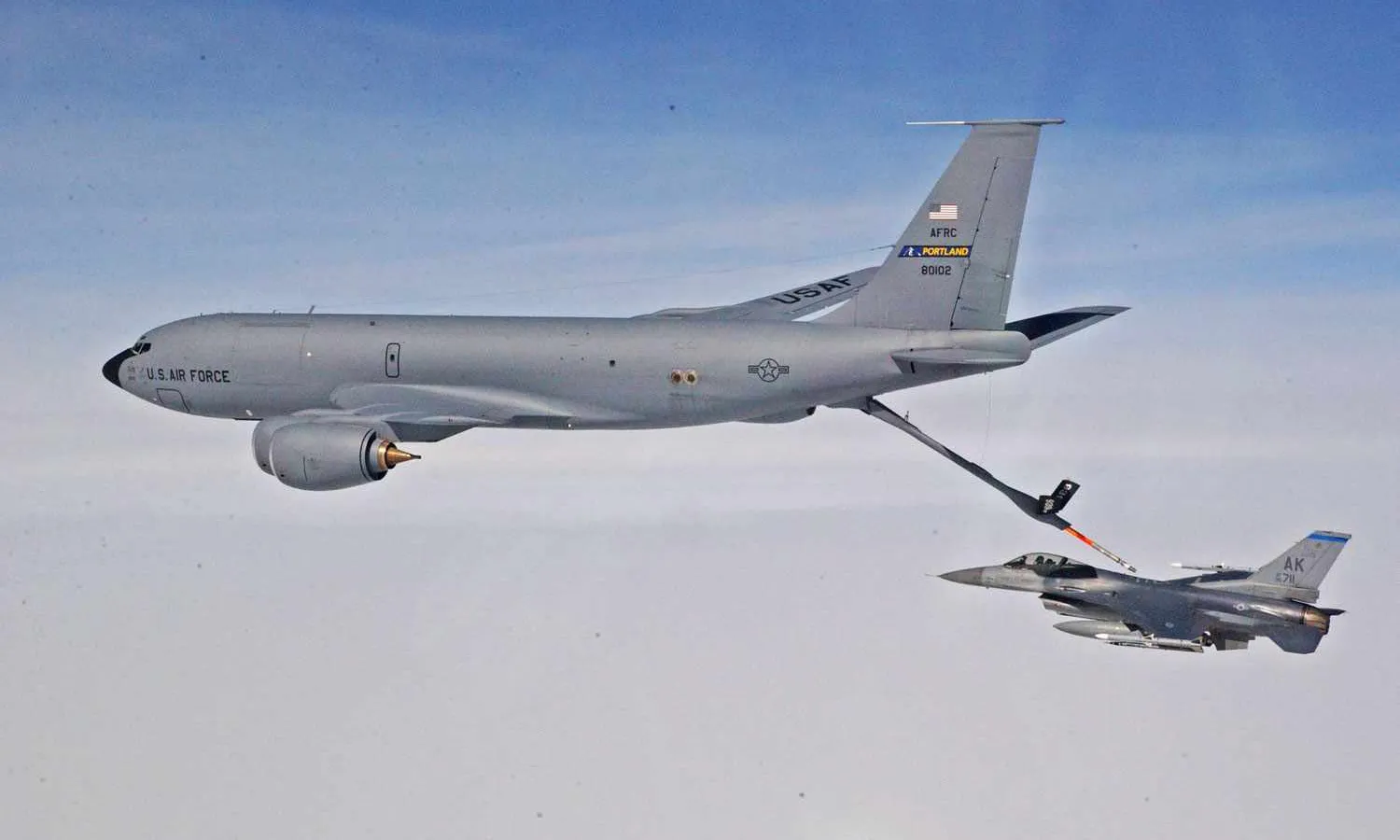
The Argentine Air Force (FAA) is evaluating potential acquisitions of the Boeing KC-135R Stratotanker to provide aerial refueling capability for its recently acquired Lockheed Martin F-16 Fighting Falcon jets.
The news was confirmed on September 1 by Brigadier Gustavo Valverde, Commander of the FAA, in an interview with journalist Nicolás Promanzio.
Currently, Argentina operates two Lockheed Martin KC-130H Hercules, which are capable of aerial refueling but are not fully compatible with the F-16’s operational requirements. According to Valverde, the FAA has formally requested two KC-135R airframes through the U.S. Foreign Military Sales (FMS) program.
The KC-130H uses the probe-and-drogue system, suitable for aircraft such as the McDonnell Douglas A-4 Skyhawk. However, the F-16 requires the flying boom refueling system, in which a rigid boom connects to a receptacle on the fighter’s fuselage — a system standard on the U.S. Air Force (USAF) fleet and employed by the KC-135 for decades.
In contrast, the U.S. Navy (USN) and U.S. Marine Corps (USMC) continue to operate the probe-and-drogue method.

Limited availability of KC-135R aircraft
Despite Argentina’s interest, no KC-135R units are immediately available for transfer. Other nations, including Denmark, are also waiting in line for potential surplus Stratotankers.
Valverde further explained that the McDonnell Douglas KC-10 Extender was considered but ruled out due to interoperability challenges with the USAF and allied air forces in the region, such as Chile, as well as standardization issues.
Once operational, the KC-135R would significantly enhance Argentina’s ability to deploy and sustain F-16 fighter operations across its vast territory, strengthening the nation’s air defense capabilities and regional interoperability.
About the Author