Bell and Boeing on track to complete deliveries of the CV-22 Osprey for the U.S. Air Force
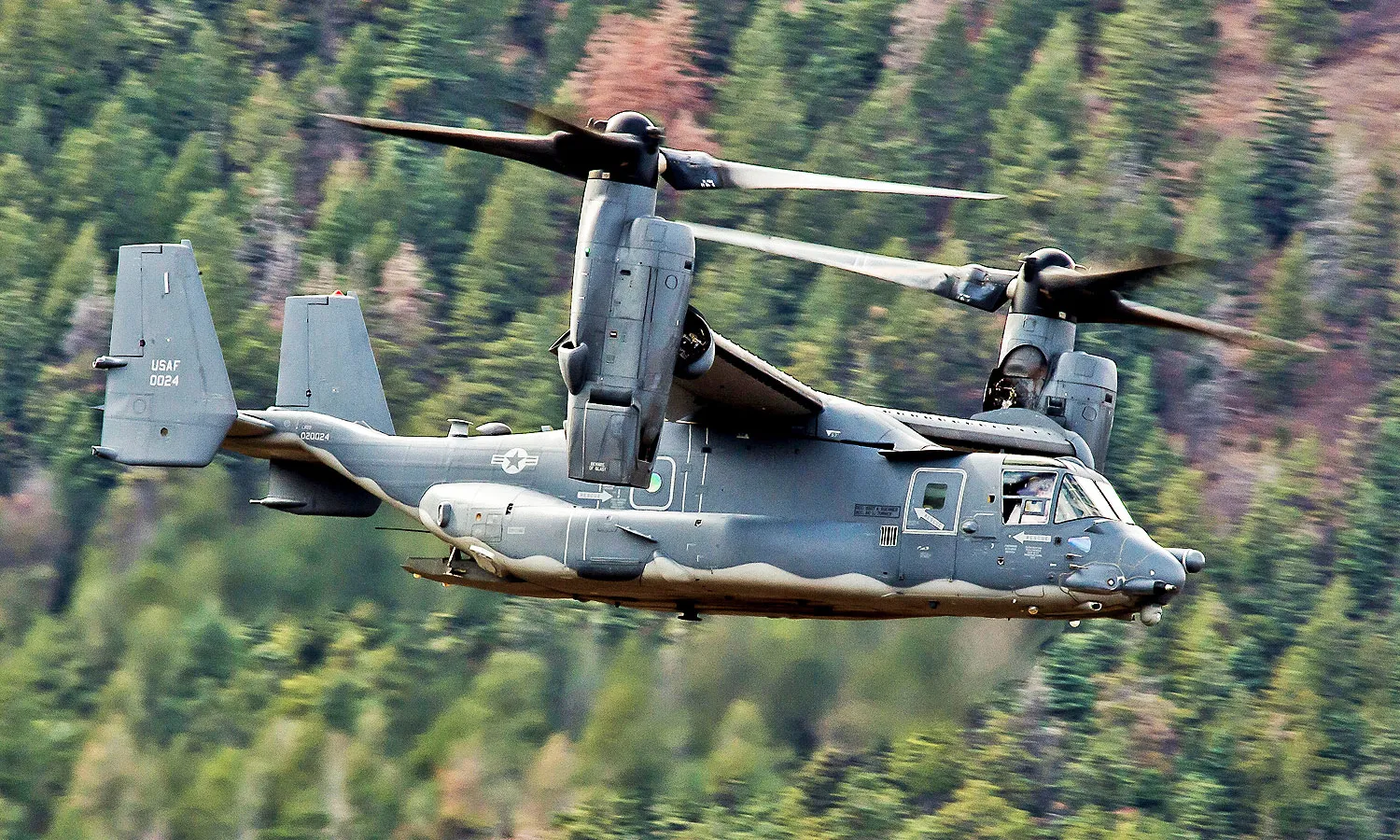
Bell and Boeing are nearing the completion of the final CV-22 Osprey ordered by the U.S. Air Force (USAF), marking the official end of production for the variant developed specifically for long-range special operations missions.
The last aircraft is currently in final assembly at Bell’s tiltrotor production facility in Amarillo, Texas, and is expected to be delivered in the coming months.
With this delivery, the USAF will close out its CV-22 acquisition program, which consisted of 56 aircraft. The Air Force will become the first of the three U.S. military branches operating the V-22 to complete its order.

“As we reach this milestone of CV-22 production we embark on the next chapter of our journey as we transition from full-rate production to fleet wide sustainment,” said Eldon Metzger, Bell’s V-22 program director.
Optimized for Long-Range Special Ops
The CV-22 is a modified variant of the V-22 Osprey, a tiltrotor aircraft developed by Bell in partnership with Boeing that combines vertical takeoff and landing capability with the cruise performance of a turboprop aircraft.
The Air Force variant includes expanded fuel capacity and advanced navigation systems, enabling deep infiltration and extraction missions for U.S. special operations forces.

One of the aircraft’s most notable missions was the longest-distance nighttime hostage rescue in U.S. military history, carried out in Africa in 2020 by the USAF’s 58th Special Operations Wing.
Production continues for the Navy and Marines
While the Air Force program is ending, Bell continues to produce the MV-22 for the U.S. Marine Corps, with around 348 units already in service.
Additionally, the CMV-22B version is being built for the U.S. Navy to replace the long-serving Grumman C-2A Greyhound in the carrier onboard delivery (COD) role. Production of the CMV-22B is expected to continue through late 2027.

Despite its operational versatility, the V-22 program has faced ongoing technical and safety challenges. In 2023, a CV-22 crash off the coast of Japan resulted in the deaths of eight U.S. airmen. The tiltrotor fleet has experienced several groundings over the years due to mechanical issues, including a near-incident in New Mexico in late 2024.
According to the Aviation Safety Network, the V-22 has been involved in 36 accidents between 1991 and 2022. In response, the U.S. Department of Defense launched two new initiatives in 2025 aimed at improving the gearbox system’s reliability and redesigning a key component known as the input quill assembly.

FLRAA
As Osprey production winds down in Amarillo over the next 18 months, Bell is preparing to shift focus to the next-generation tiltrotor for the U.S. Army under the Future Long-Range Assault Aircraft (FLRAA) program.
Six prototype aircraft of the V-280 new tiltrotor aircraft are currently under contract, with initial low-rate production expected to begin by 2030.
The final CV-22 delivery marks the end of nearly two decades of production for the USAF’s specialized Osprey fleet — a significant milestone in modern military aviation.
About the Author

Ricardo Meier
Creator of the website that started in 1996 as a magazine. He also writes on Brazilian websites AUTOO, MOTOO and MetrôCPTM.