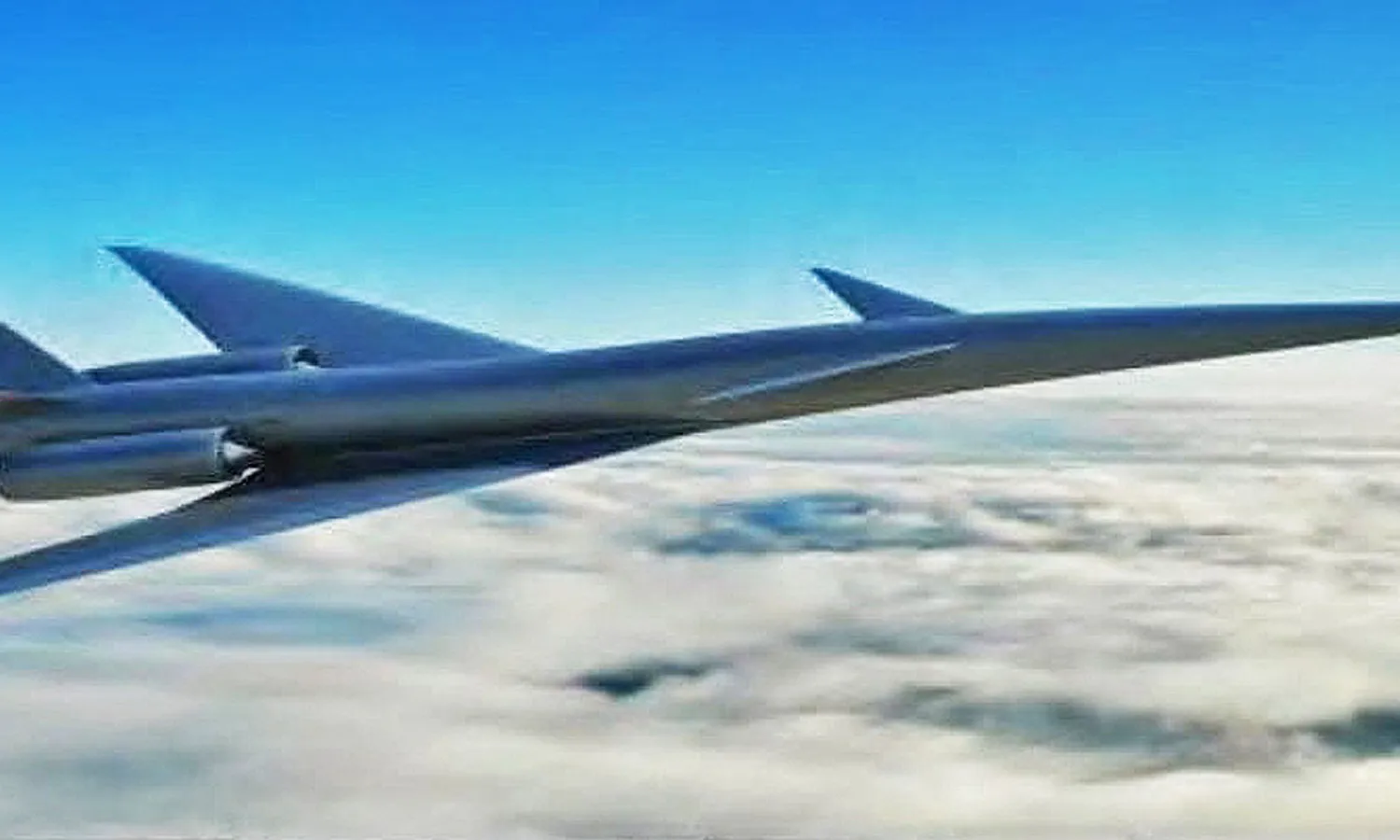
'Chinese Concorde': COMAC outlines the supersonic C949
COMAC is thinking big, and we’re not talking about its current commercial jets and future widebodies. The Chinese state-owned aircraft manufacturer is already making plans to launch a supersonic passenger jet.
The first outlines of the C949 were discreetly revealed by the company in recent weeks as an academic paper, but it has the goal of putting the aircraft on the market by 2049.
The C949, in its first configuration, has super-swept wings, canards and a V-tail. Two engines installed at the rear of the fuselage will be responsible for propelling the jet up to Mach 1.6.

The “Chinese Concorde”, if it will not be as fast as the original, will at least carry more passengers (168 seats) and will be quieter, emitting a maximum of 89.3 decibels.
As a bonus, it will fly further, with a range 50% greater than the Anglo-French jet, or around 6,800 nm/11,000 km.
Race for the new supersonic airliner
A presentation with the COMAC logo shows the C949 as the company’s next aircraft, after the wide-bodies C929 and C939, and is therefore expected to enter service well after Boom Supersonic’s Overture.

The US company is at the forefront of the race for the new supersonic airliner, having recently completed test flights with the experimental XB-1 jet.
In this sense, Boom claims to have managed to avoid the characteristic bang when flying over inhabited areas, one of the obstacles to the project’s success.
The company says it has found a ‘niche’ where shock waves would not reach the surface, but the concept still needs to be proven to aviation regulators.
NASA, in partnership with Lockheed Martin, is close to completing the maiden flight of the X-59 aircraft, a concept that uses a unique configuration to slow down the shock waves generated by the supersonic boom.

The experiment is considered the most promising for solving this problem, which prevented the Concorde from flying over US territory above the speed of sound.
Although it is behind schedule, COMAC has one advantage: the full support of the Chinese government to accelerate the program to “supersonic” speeds, if necessary.
About the Author

Ricardo Meier
Creator of the website that started in 1996 as a magazine. He also writes on Brazilian websites AUTOO, MOTOO and MetrôCPTM.


