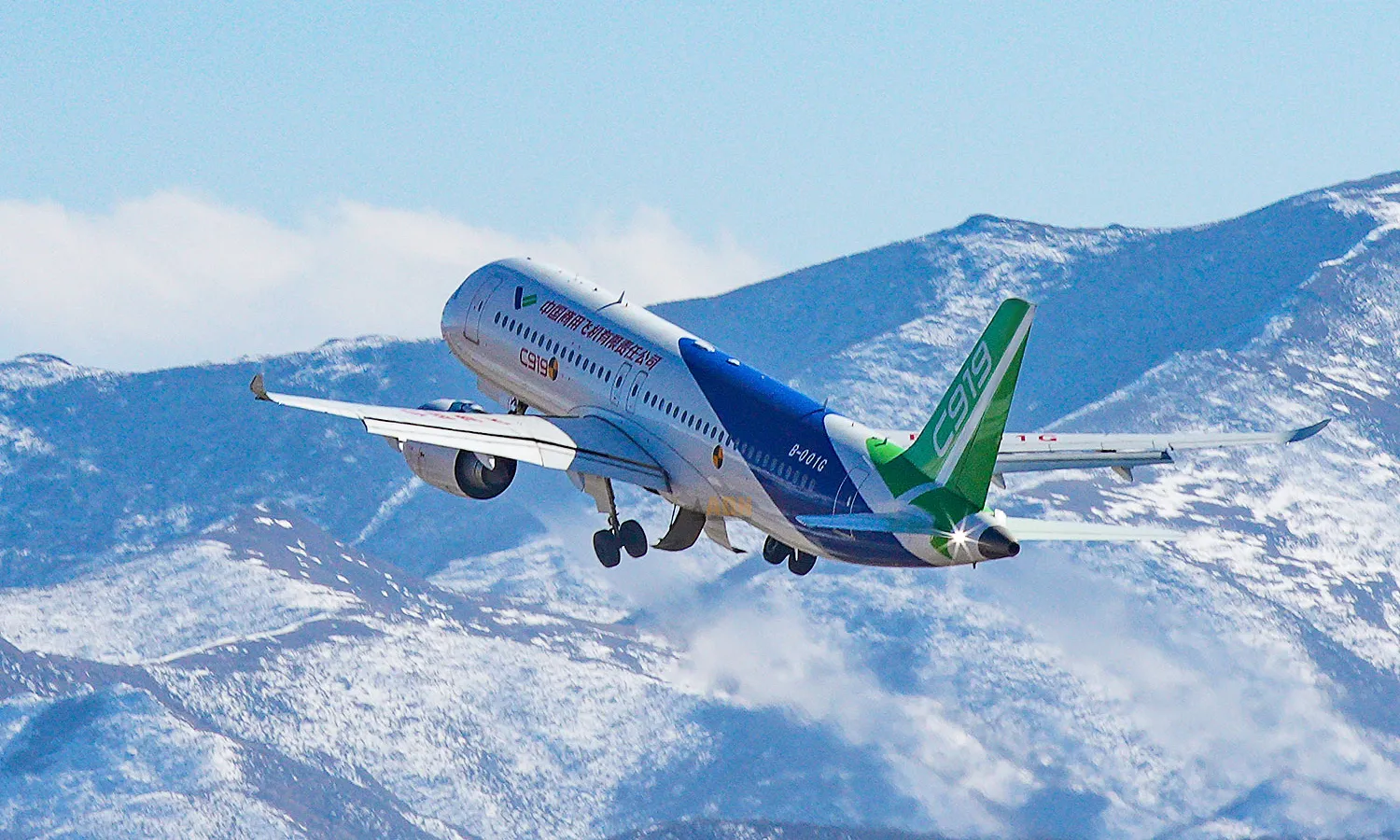
Dependent on the West, the C919 aircraft may suffer from the trade war between the US and China
The trade war between the US and China has hit Boeing hard, with deliveries of aircraft to Chinese airlines suspended due to high tariffs imposed by President Donald Trump.
Boeing 737 MAX jets that had flown to the country in March returned to Seattle last month, at the behest of Xi Jinping’s government.
Although the US planemaker has a good volume of aircraft pending delivery to Chinese customers, Boeing CEO Kelly Ortberg has downplayed the impact of the trade dispute so far.
Thanks to strong global demand, there are lines of buyers for its jets, especially the 737 MAX. At least two airlines, Malaysia Airlines and Air India, have expressed interest in taking over aircraft rejected by the Chinese.
But if Boeing seems calm, the Chinese state-owned manufacturer COMAC may be in trouble.

In full expansion of the production of its commercial jets, the company has a large order book and a factory that is still far from ideal.
Some 50 C919s are expected by 2025, the most advanced and capable Chinese commercial aircraft, which is similar in size to the 737 and the Airbus A320.
Leap-1C engines
But, despite having been developed locally, the C919 is an essentially global aircraft. And worse than that, it depends on many components from the US.
It is no wonder that analysts interviewed by the Financial Times have expressed concern that COMAC could be seriously harmed by the relations between Trump and Xi Jinping.

Although demand for components is currently modest compared to the production pace of Boeing and Airbus, the C919 will need many Leap-1C engines, which are manufactured by CFM International, a joint venture between Safran of France and GE Aerospace of the United States.
The turbofan has been experiencing production delays that have affected all three single-aisle jets on the market. The turbofan is assembled in France, but the core module comes from Ohio.
A path already taken by the Russians
A worsening of relations could put COMAC on the same painful path as the United Aircraft Corporation (UAC), Russia’s state-owned aerospace company.
The company had another aircraft in the same category in advanced development, the MC-21, originally from Irktut and now associated with Yakovlev.

The 211-seat jet was equipped with Pratt & Whitney GTF engines, but since the beginning of the first sanctions, Russia has been working on the PD-14 turbofan to replace it.
In addition, the aircraft’s ‘Russification’ process included avionics, equipment and wings made of composite material. Despite the greater expertise in aircraft production, the conversion of the MC-21 to a Russian-made recipe has taken a long time.
China, despite its unparalleled industrial capacity, lacks precisely these more advanced equipment and systems.

There is a local engine, the CJ-1000A, that has been under development for years, but to date it has only been seen in flight tests on other aircraft.
COMAC also depends on companies such as Honeywell, Collin Aerospace, Crane and Parker Aerospace for other parts and devices.
If Trump bans the supply, the C919 could at best have its production suspended for several years until its contents could be replaced with similar Chinese ones.
Meanwhile, the country’s major carriers such as Air China, China Southern Airlines and China Eastern Airlines would be in a delicate situation, unable to receive more Boeings and on the huge waiting list for Airbuses.
Now it remains to be seen who has the most cards up their sleeve to play this game.
About the Author

Ricardo Meier
Creator of the website that started in 1996 as a magazine. He also writes on Brazilian websites AUTOO, MOTOO and MetrôCPTM.


