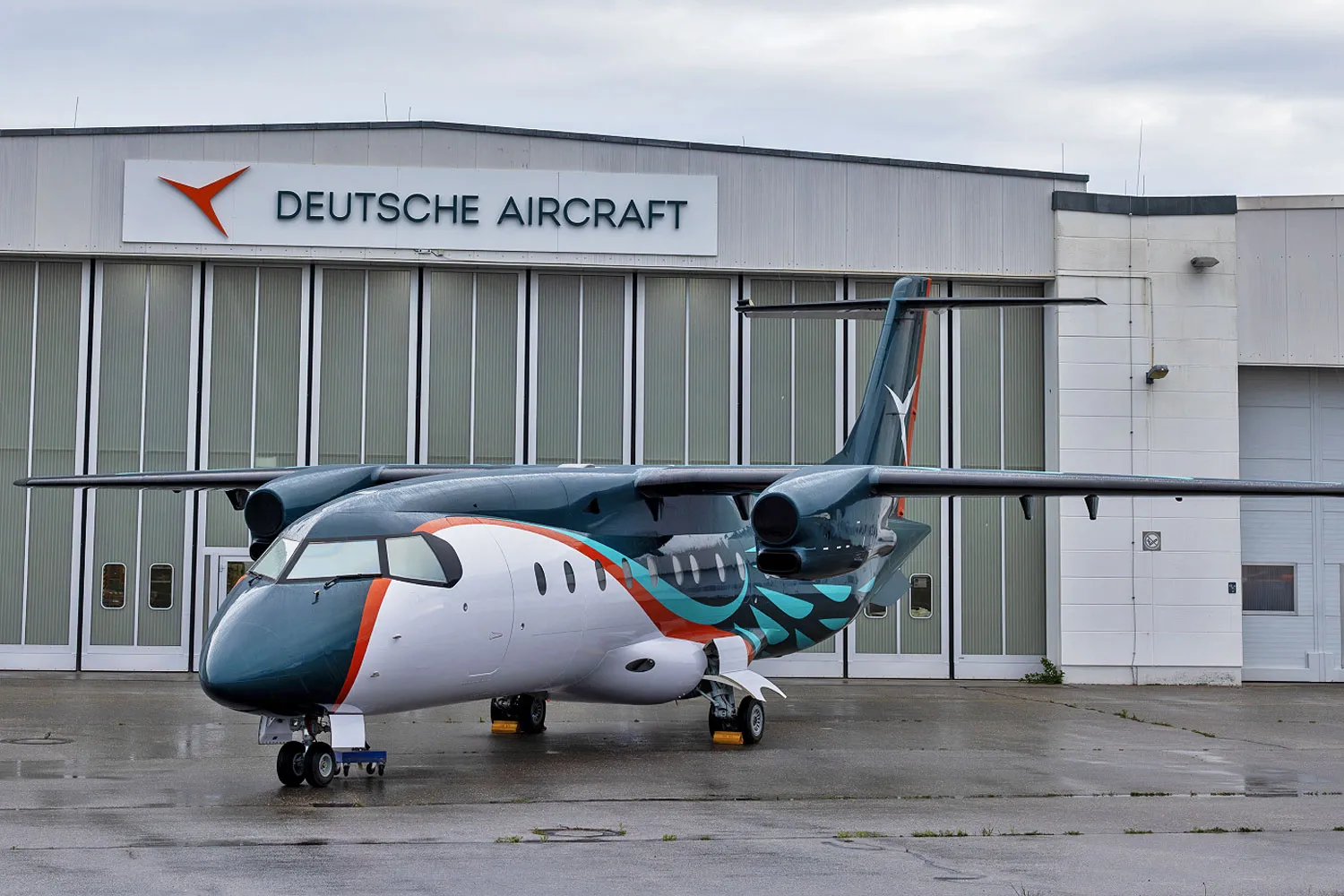
Deutsche Aircraft unveils first prototype of the D328eco
Deutsche Aircraft held the official presentation of the first prototype of the D328eco, called TAC 1, in Oberpfaffenhofen (Germany).
The aircraft will serve as the basis for the flight test campaign of the new, upgraded and larger-capacity variant of the Dornier 328, aimed at the regional aviation segment.
The event took place less than a year after the initial fuselage cut, announced during the 2024 Farnborough Airshow, and represents the transition of the program from the conceptual engineering phase to the practical testing and certification stage.
The TAC 1 aircraft, however, is still without its two Pratt & Whitney PW127 turboprop engines.
Based on an existing design
The D328eco is not a completely new design, but rather an evolution of the Dornier 328, a turboprop with capacity for around 30 passengers that entered service in the early 1990s.

The new version uses the basic structure of the original aircraft, with modifications to the aerodynamics, engine, avionics and manufacturing processes, in order to meet current operational and environmental requirements. According to the manufacturer, the model will maintain the capacity to operate on short runways and remote locations.
Deutsche Aircraft’s goal is to obtain certification of the model and begin deliveries from the fourth quarter of 2027.
Development and certification stages
With the prototype completed, the manufacturer will begin the flight test campaign, which will be conducted in cooperation with regulatory authorities and international suppliers.
The company also highlighted the use of technologies aimed at reducing emissions and fuel consumption, one of the main focuses of the program.

The presentation of the prototype was attended by representatives of the Bavarian government, federal authorities, suppliers and members of the press, signaling institutional support for the resumption of an aircraft project with local production and a focus on regional operations.
Deutsche Aircraft is betting that the D328eco will be able to fill gaps in the supply of aircraft for short routes, especially in markets seeking alternatives with less environmental impact and the capacity to operate in limited infrastructure.
It will compete with the ATR 42, which has dominated sales in the category for a few decades.
About the Author

Ricardo Meier
Creator of the website that started in 1996 as a magazine. He also writes on Brazilian websites AUTOO, MOTOO and MetrôCPTM.


