Defense
Dutch F-35A shoots down Russian drone after Polish airspace incursion
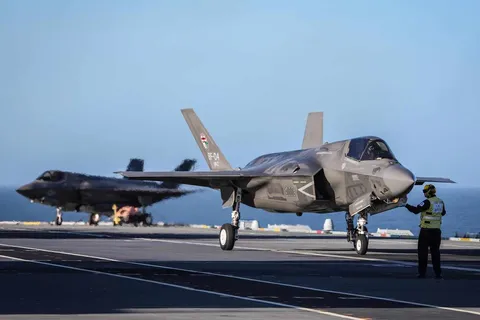
A Dutch Air Force F-35A Lightning II fighter shot down a Russian-made drone that crossed into Polish airspace from Belarus in early September, marking the first confirmed aerial kill for the Netherlands’ F-35 fleet.
According to the Dutch Ministry of Defence, the incident occurred at approximately 23:30 on September 9, when around 23 drones violated Polish airspace, triggering a rapid NATO air response.
The drone downed by the Dutch aircraft was identified as a Shahed model, with photographic evidence showing the F-027 jet of 313th Squadron bearing a silhouette marking of the engagement beside its canopy.
Following the airspace infringement, Polish authorities closed several airports as a precaution. At least four drones were destroyed during the episode, the majority by Dutch F-35s, while some were later confirmed to be decoy models resembling Gerbera drones. Polish officials described the breach as an unprecedented attack on NATO territory.

The Dutch Air Force had deployed its F-35A jets to Poland starting September 1, as part of a scheduled NATO air policing rotation set to run through December. The mission focuses on safeguarding NATO airspace and deterring further Russian incursions, particularly along the alliance’s eastern borders.
The F-35A, a fifth-generation multirole stealth fighter, is equipped with advanced sensors and weapons systems suited for both air-to-air and air-to-ground operations. This engagement represents a significant operational milestone for the Royal Netherlands Air Force, underscoring the platform’s role in joint NATO defense measures.
In the aftermath, Russia and Belarus conducted large-scale joint military exercises, while NATO launched Operation Eastern Sentry to reinforce its eastern flank.
European countries are now discussing the implementation of an anti-drone barrier along borders with Russia and Belarus, though specific technical details have not been released.
About the Author

Ricardo Meier
Creator of the website that started in 1996 as a magazine. He also writes on Brazilian websites AUTOO, MOTOO and MetrôCPTM.