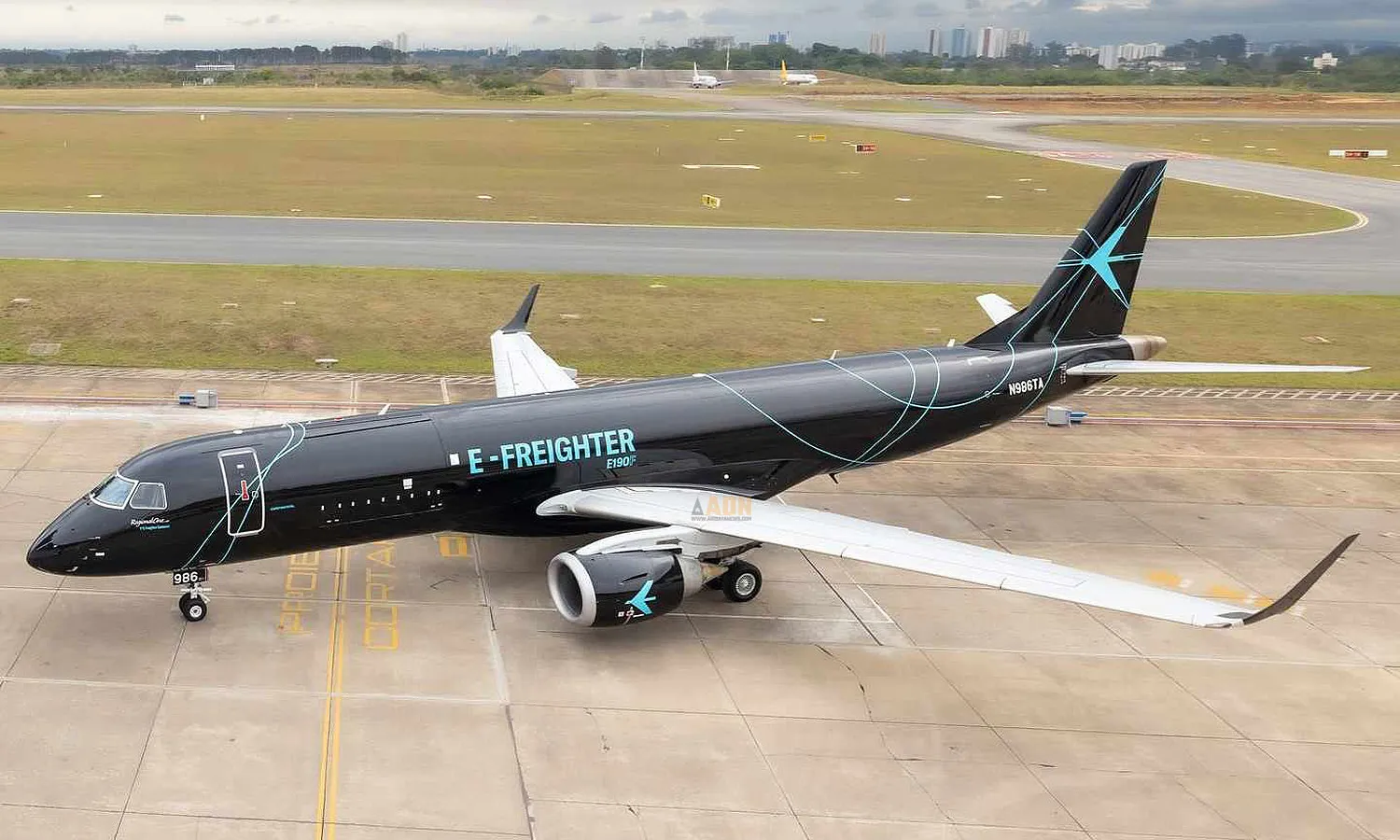
Embraer revises plans and will focus solely on the E190F freighter
The E-Freighter conversion project, launched by Embraer in 2022, has had its plans changed by the company.
Previously proposed for two aircraft, the program will focus solely on the E190F variant, revealed the company’s CEO, Francisco Gomes Neto.
“Our plans are to introduce this product [E190F] to the market. That’s what we’re focused on,” said Embraer’s chief executive.
“If everything works well, we can think about taking another step towards the E195[F],” added Gomes Neto. The aircraft is larger and will be able to carry up to 14.3 tons of cargo.

Passenger to Cargo conversion
Embraer launched the E-Freighter program three years ago, riding the wave of e-commerce growth caused by the Covid-19 pandemic.
The plan was to use hundreds of E190 and E195 jets to undergo the so-called P2F (Passenger to Cargo) conversion, as is done with the Boeing 737-800BCF and the Airbus A320P2F.
To this end, a passenger aircraft undergoes a reconfiguration, with the removal of seats, emergency oxygen systems, bins, galleys and other unnecessary equipment.

The jet then receives a reinforced floor, fire sensors and, above all, a wide cargo door in the front portion of the fuselage.
Converted for cargo, the E190F can transport up to 13.5 tons in its upper and lower compartments, a capacity intermediate between an ATR 72F and a Boeing 737 freighter.
Single aircraft still not in operation
Three groups have closed deals for the freighter variant: the lessors Nordic Aviation Corporation (NAC) and Regional One, as well as Lanzhou Aviation Industry Development Group, from China.
In all, 40 aircraft have been ordered, but so far only one E190F has been completed, N986TA, which served as a demonstration aircraft and belongs to Regional One.

The aircraft, however, has reportedly been parked at Embraer’s facilities since March 29 after a local flight.
According to reports, the heated demand for pre-owned commercial aircraft amid supply chain issues for new aircraft may have reduced interest in the conversion.
In recent statements, executives from the manufacturer said that the E190F would be delivered soon and that the conversion work in the future should be passed on to MRO (Maintenance, Repair and Overhaul) companies, which can offer the service at lower prices.
About the Author

Ricardo Meier
Creator of the website that started in 1996 as a magazine. He also writes on Brazilian websites AUTOO, MOTOO and MetrôCPTM.


