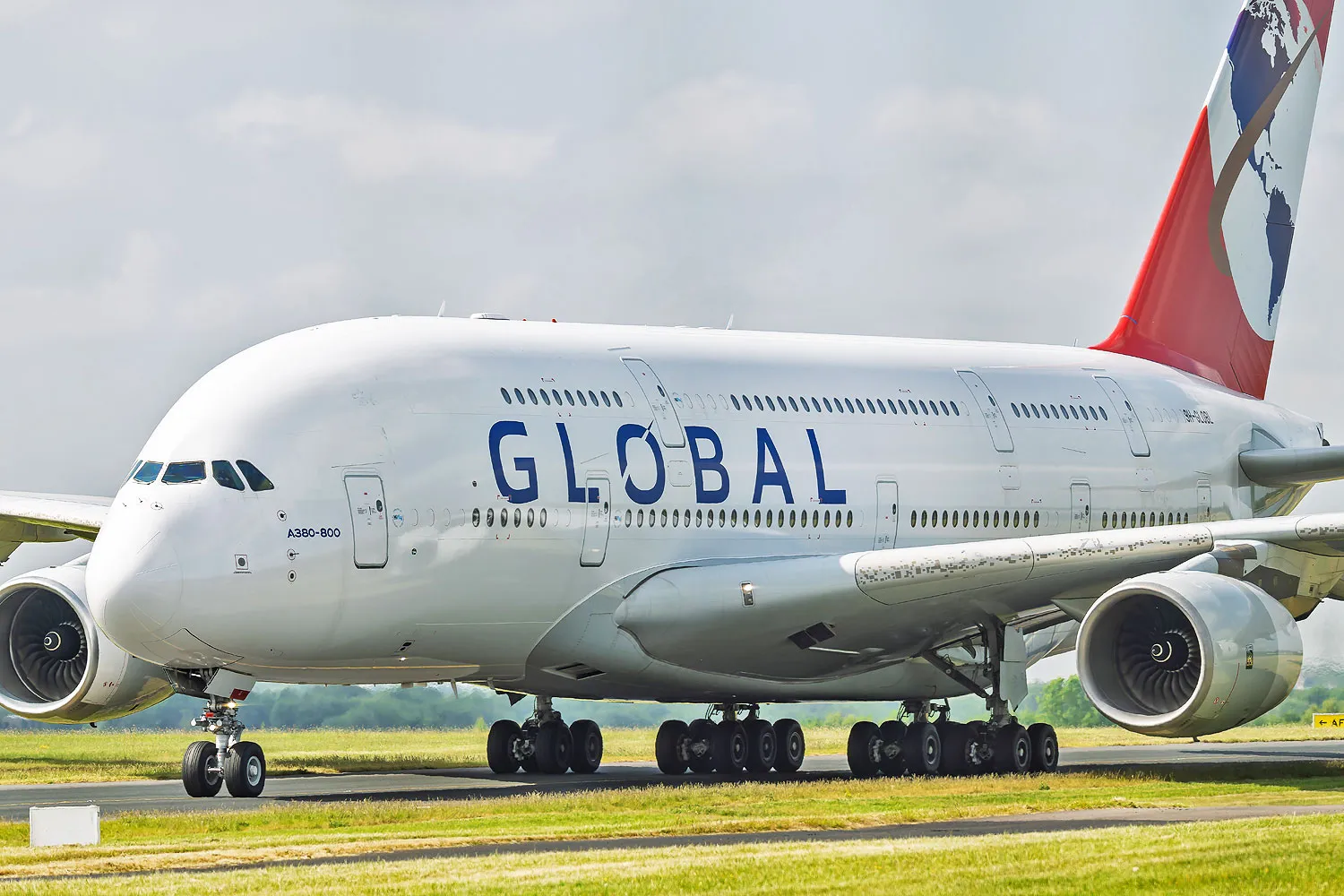
Global Airlines expected to shift away from scheduled operations and focus on A380 charter services
Global Airlines, the UK-based startup founded by former investment banker James Asquith, is reportedly undergoing a strategic shift and is set to abandon its original plan to launch scheduled flights under its own brand, according to reports.
Instead, the company is preparing to adopt an ACMI model (Aircraft, Crew, Maintenance, and Insurance), offering its aircraft for charter to other carriers.
The shift comes after Global Airlines completed its first two commercial demonstration flights in May using its sole Airbus A380, acquired from China Southern Airlines. The inaugural flight was conducted on May 15, operating from Glasgow, Scotland, to New York JFK.
A second flight followed on May 21, departing from Manchester to the same destination. Both flights were operated by Portuguese wet-lease partner Hi Fly, as Global has not yet obtained its own UK Air Operator Certificate (AOC).

The airline’s A380, registered 9H-GLOBL, retains the original interior layout used during its service with China Southern and has undergone a light cabin reconfiguration.
Saudi investment and ACMI focus
According to Arabian Aerospace, Global Airlines is in talks to secure investment from Kingdom Holdings, a Riyadh-based conglomerate founded by Prince Alwaleed bin Talal Al Saud. The group holds stakes in various sectors, including the Saudi low-cost carrier Flynas, which recently launched an IPO.
The new capital would allow Global to accelerate plans to acquire three additional A380s, which have already been identified and are currently under negotiation. If finalized, this move would position Global Airlines as the world’s first A380-dedicated ACMI operator.

The shift in strategy coincides with a global surge in demand for widebody aircraft on short- and medium-term leases, partly due to ongoing delivery delays from Airbus and Boeing. This has created opportunities for high-capacity aircraft like the A380 to find renewed relevance in more flexible, contract-based operations.
Global Airlines initially drew attention by proposing to bring the A380 back into scheduled passenger service. However, regulatory hurdles, high operating costs, and the challenge of consistently filling such a large aircraft have led the company to reconsider its original business model.
About the Author

Ricardo Meier
Creator of the website that started in 1996 as a magazine. He also writes on Brazilian websites AUTOO, MOTOO and MetrôCPTM.


