Lifting Bodies: NASA’s wingless aircraft that paved the way for the Space Shuttle
Long before the Space Shuttle reentered Earth’s atmosphere and landed like a glider, NASA engineers had to answer a bold question: Can you fly an aircraft without wings?
That answer came in the form of lifting bodies, experimental vehicles designed to generate lift through their fuselage shape alone.
Starting in the 1960s, these unique aircraft helped prove the aerodynamic viability of wingless flight, shaping the future of spaceplane design.
M2-F1: The “Flying Bathtub”
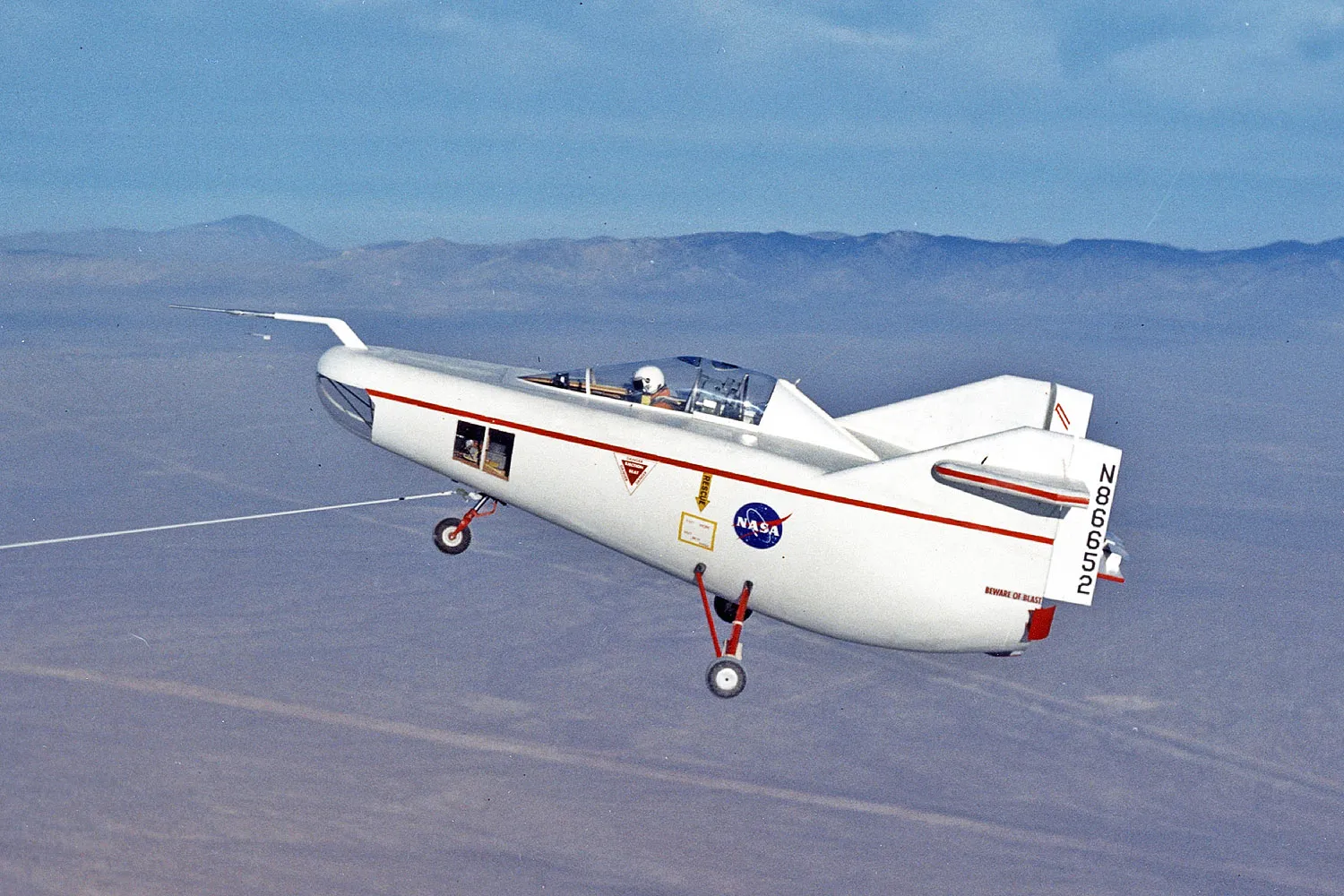
The M2-F1, built in 1963, was NASA’s first crewed lifting body. Its lightweight structure was made of a steel tube frame covered in plywood, and its odd look earned it the nickname “flying bathtub.”

Unlike traditional aircraft, the M2-F1 had no wings. Its lift came from its teardrop-shaped fuselage, which redirected airflow to keep the aircraft aloft.
Initial test runs were done on dry lakebeds using a Pontiac Catalina as a tow car. Later, the M2-F1 was dropped from a Douglas C-47 aircraft for higher-altitude glides.
These flights confirmed that wingless designs could be stable, controllable, and capable of safe landings on conventional runways.

Advancing the Concept: M2-F2, HL-10, X-24 and More
The M2-F1’s success led to a series of more advanced lifting bodies. The Northrop M2-F2 and M2-F3 are heavier, metal-clad successors to the M2-F1.
The M2-F2, however, crashed in 1967, but was rebuilt as the more stable M2-F3.
The same manufacturer developed the HL-10, one of the most successful designs of a lifting body aircraft.

The HL-10 reached speeds of Mach 1.86 and altitudes over 90,000 feet, showing that lifting bodies could operate in supersonic and high-altitude regimes.
The X-24A and X-24B are developed by Martin Marietta and tested alternative shapes and reentry profiles. The X-24B’s sleek redesign played a critical role in refining landing dynamics for future spacecraft.
These aircraft were typically launched from B-52 bombers, then completed unpowered glide flights and landed on dry lakebeds, simulating space reentry and recovery.

Space Shuttle glider
The most direct legacy of the lifting body program was the Space Shuttle, whose fuselage-based lift and glider-like landings were directly inspired by these early designs.
Today, the concept lives on in spacecraft like the Dream Chaser, developed by Sierra Nevada Corporation. Designed as a modern lifting body, it will transport cargo—and possibly crew—to the ISS, returning to Earth via conventional runways.

The lifting body program proved that with the right fuselage shape, wings aren’t always necessary. These wingless pioneers were key in bridging the gap between expendable rockets and the reusable spacecraft of today.
Far from being just engineering curiosities, NASA’s lifting bodies were bold experiments that reshaped both aerospace technology and space exploration strategy.

NASA Lifting Bodies Timeline
| Year | Model | Description | Max Speed | Max Altitude |
|---|---|---|---|---|
| 1963 | M2-F1 | First manned lifting body; plywood build | ~135 km/h (tow tests) | ~4,000 ft |
| 1966 | M2-F2 | First all-metal lifting body | Mach 1.6 | 71,500 ft |
| 1969 | M2-F3 | Improved version with vertical fin | Mach 1.6 | 72,000 ft |
| 1966 | HL-10 | Best performance; sleek design | Mach 1.86 | 90,303 ft |
| 1970 | X-24A | Rounded design; early X-series lifting body | Mach 1.6 | 71,400 ft |
| 1973 | X-24B | Sharper, more reentry-like design | Mach 1.76 | 74,100 ft |
About the Author

Ricardo Meier
Creator of the website that started in 1996 as a magazine. He also writes on Brazilian websites AUTOO, MOTOO and MetrôCPTM.


