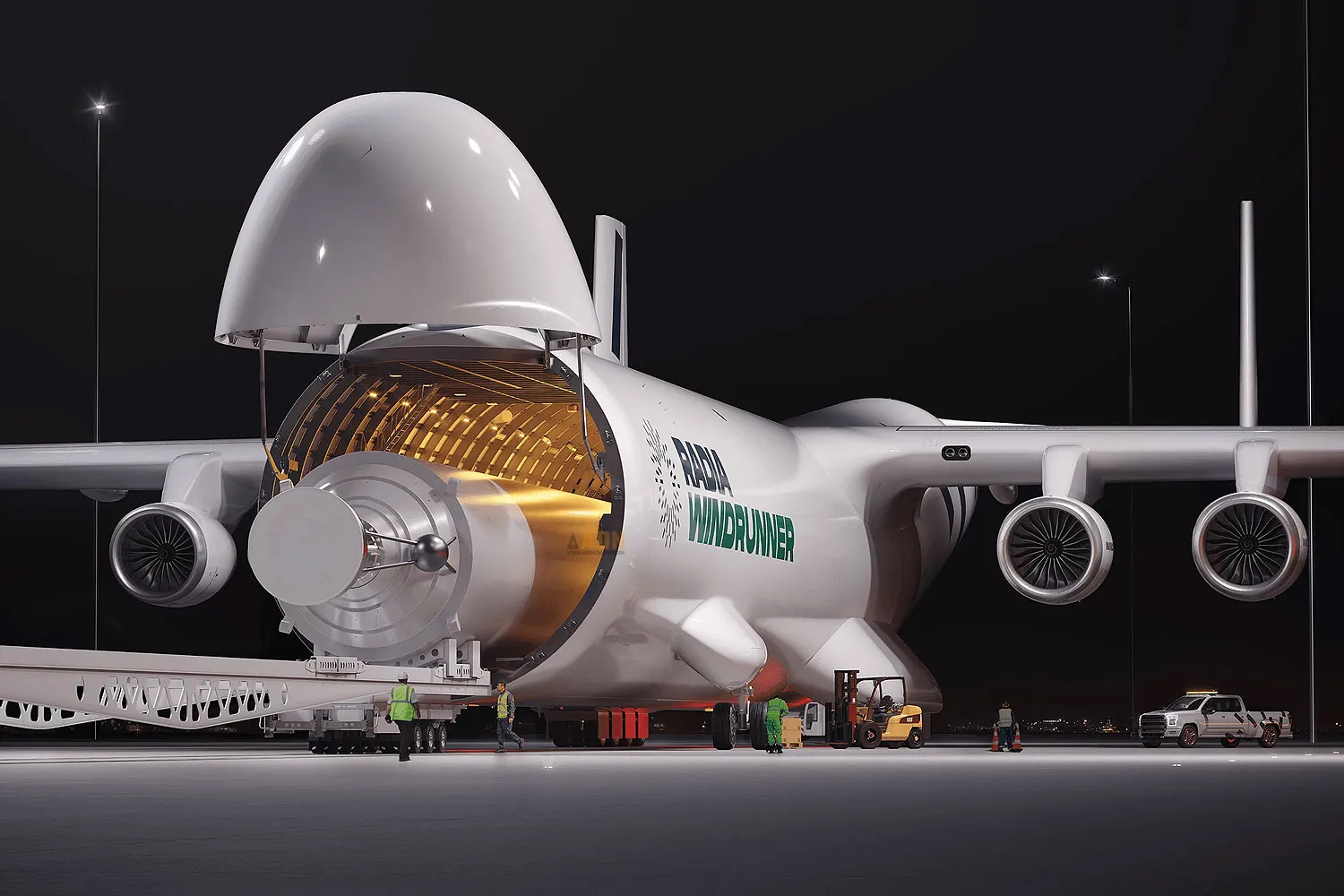
Massive cargo plane project moves forward with new partners
The payload capacity of 72.6 tons is not impressive, nor is its low speed for a jet (Mach 0.6), but the WindRunner makes up for these issues with superlative dimensions.
Radia’s four-engine cargo plane aims to be the world’s largest and offer transport services for huge components such as wind turbine blades, satellites and armored vehicles.
The Colorado-based company will participate for the first time in the Paris Air Show, from June 16 to 19 in France, and on Tuesday revealed more partners in the program.

These companies are Akaer (aircraft pressurized cabin and systems integration), Aciturri Aeronáutica (composite tail structure), Astronautics Corporation of America (leading avionics systems integrator), Element Digital Engineering (fuel system design and integration) and Ingenium Technologies (high-lift control system).
They join Leonardo, MAGROUP Magnaghi Aerospace, Aernnova and AFuzion, which are already involved in the project.

12 times more volume than a Boeing 747F
The WindRunner is a high-wing, twin-tail aircraft designed to offer an unparalleled cargo hold. Even the cockpit has been moved to the top of the fuselage to facilitate the accommodation of bulky items.
According to Radia, the aircraft offers 12 times more space than a Boeing 747-400F, that is, 7,700 m³ versus 610 m³.

With a length of 108 meters and a wingspan of 80 meters, the WindRunner is intended to fly 2,000 km at an altitude of 12,500 meters and operate on unprepared runways of 1,800 meters.
If it is manufactured, the four-engine cargo aircraft will be an alternative to the Antonov An-124, currently the aircraft with the largest cargo capacity on the market.
The special cargo segment, however, may not be as attractive as one might think. Airbus tried to use its first-generation Belugas in an airline dedicated to this mission, but gave up before winning customers.

In favor of the WindRunner is the fact that the aircraft can operate without ground support – the Beluga, with its design adapted from a commercial jet, needs special equipment to load and unload its cargo.
“WindRunner is more than an aircraft; it’s a global response to one of the most pressing logistics problems of our time,” guarantees Mark Lundstrom, founder and CEO of Radia.
About the Author

Ricardo Meier
Creator of the website that started in 1996 as a magazine. He also writes on Brazilian websites AUTOO, MOTOO and MetrôCPTM.


