Defense
MBDA secures new Meteor missile order from Germany
MBDA has received a new contract to supply additional Meteor beyond-visual-range air-to-air missiles to the German Armed Forces, reinforcing Germany’s inventory of long-range air combat weapons.
The order was placed through the Meteor Integrated Joint Program Office on behalf of Germany’s Federal Office of Bundeswehr Equipment, Information Technology and In-Service Support, continuing a series of previous procurements for the missile.
Meteor is a multinational European program involving Germany, the United Kingdom, France, Italy, Spain and Sweden, with MBDA acting as prime contractor. The missile is powered by a ramjet propulsion system developed by MBDA subsidiary Bayern-Chemie in Germany, allowing sustained thrust throughout the engagement and giving Meteor a larger so-called “no-escape zone” than many conventional air-to-air missiles.
The weapon is already operational on several fighter types, including the Eurofighter Typhoon, Dassault Rafale and Saab Gripen, and is also being integrated on the KF-21 Boramae.
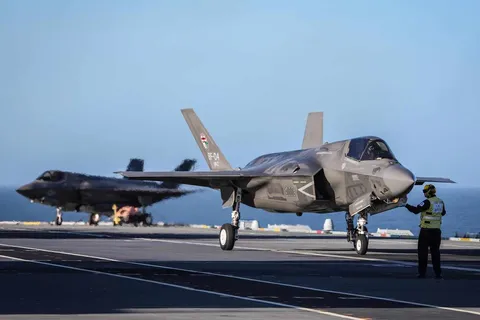
In 2025, the program advanced further with the first Meteor flight on the F-35B and ground testing ahead of flight trials on the F-35A. That same year, the Brazilian Air Force confirmed a successful Meteor test firing from its F-39E Gripen fighters.

For Germany, Meteor’s primary operational role is tied to the Luftwaffe’s Eurofighter Typhoon fleet. German Eurofighters began early carriage and integration activities with Meteor in 2021, followed by the first live firing of the missile from a German Typhoon during a test campaign at RAF Lossiemouth in December 2024.
German defence officials have repeatedly described the missile as central to the aircraft’s beyond-visual-range capability.
The new order comes as European air forces place greater emphasis on maintaining sufficient missile stocks for air policing, deterrence and potential high-intensity scenarios.
The Meteor is seen not only as a procurement item but as a key enabler of long-range engagement, allowing German fighters to contest and deny airspace without having to close into shorter-range combat envelopes.
About the Author

Ricardo Meier
Creator of the website that started in 1996 as a magazine. He also writes on Brazilian websites AUTOO, MOTOO and MetrôCPTM.