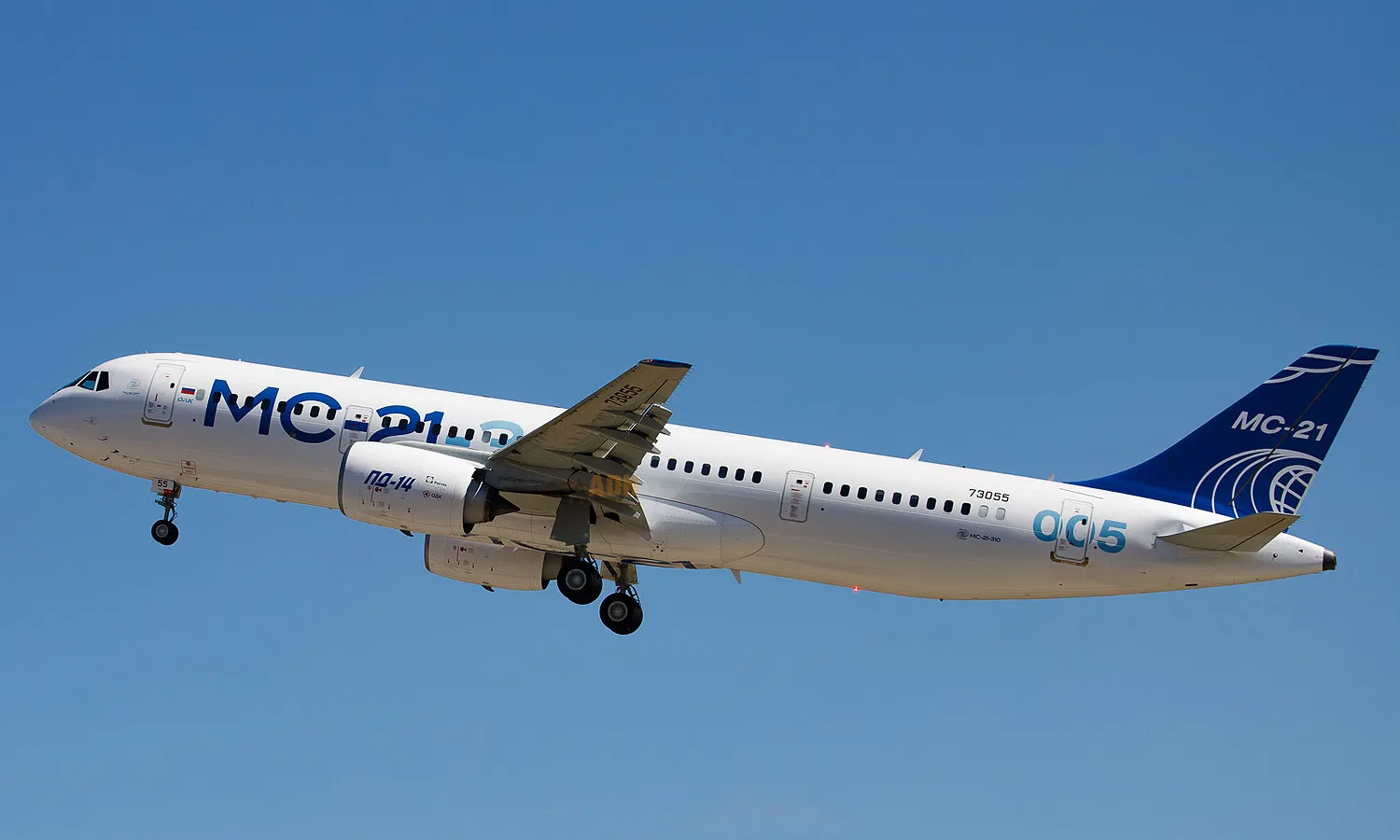
MC-21 Airliner Makes Maiden Flight with Russian Components
Days after flying a prototype of the ‘Russified’ SJ-100 regional jet, Yakovlev has done something similar with the MC-21, a narrow-body airliner with 211 seats.
Test aircraft number 005 (registration (73055)) took off from the Irkustk facility for a 1 hour and 15 minute flight reaching 580 km/h and an altitude of 3,000 meters.
According to the United Aircraft Corporation (UAC), the parent company of the Yakovlev manufacturer, this marks the beginning of flight tests for the development of the production variant of the MC-21.
Two prototypes modified with Russian components will be part of the test program for certification of the aircraft in the MC-21-310 variant.

“The MC-21 is designed to replace Boeing and Airbus in the skies of Russia. It is an advanced aircraft in terms of characteristics, very modern and comfortable, with exceptional aerodynamics and new generation onboard systems. Combined with the PD-14 engines, this ensures low operating costs and good savings for airlines,” said Oleg Yevtushenko, CEO of Rostec, Russia’s state technology company.
However, Tuesday’s flight took place not yet replaced in all systems. According to UAC, the aircraft has received a set of Russian-made avionics equipment, including computers, navigation systems and radio communications equipment, as well as a domestic auxiliary power unit, air conditioning and pressure control systems, among others.

Replacement for the Boeing 737 and Airbus A320
The MC-21-310 also flies with the PD-14 turbofan, developed to replace the Pratt & Whitney GTF that equipped the first prototypes.
The aircraft is expected to replace Boeing 737 and Airbus A320 family jets that fly with Russian airlines and are subject to economic sanctions following Russia’s military invasion of Ukraine.
“Our plans include a flight to Zhukovsky to perform flights as part of the certification test program. In parallel, we continue to work on the all-Russian MC-21, which is now in the final assembly shop and will take part in flights later,” noted UAC CEO Vadim Badekha.
The start of serial production of the MC-21 has been postponed several times, but is scheduled for the second half of 2026, Anton Alikhanov, Minister of Industry and Trade, said in March.
About the Author

Ricardo Meier
Creator of the website that started in 1996 as a magazine. He also writes on Brazilian websites AUTOO, MOTOO and MetrôCPTM.


