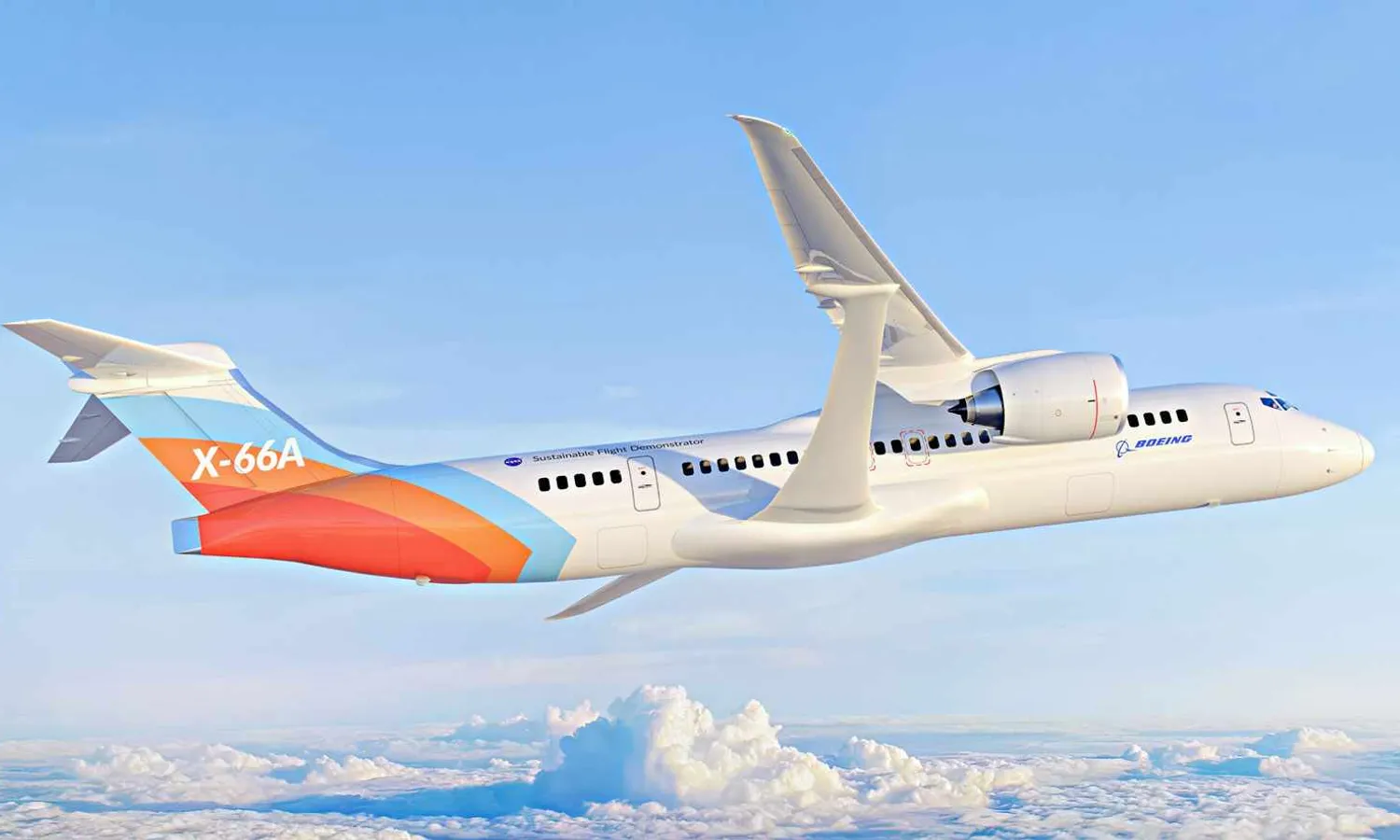
NASA and Boeing Reassess Focus of X-66 Project with Ultra-Thin Wings
NASA and Boeing have announced a shift in strategy for the X-66 project, an experimental aircraft featuring long, ultra-thin wings aimed at achieving sustainable commercial aviation.
Instead of moving forward immediately with the construction of a full-scale flight prototype— known as the Sustainable Flight Demonstrator (SFD) —the program’s focus will pivot toward detailed ground testing and validation of the transonic truss-braced wing (TTBW) technology.
The goal of the reassessment is to better understand the structural and aerodynamic challenges of the concept before proceeding to the manufacturing stage.
According to NASA, the decision is intended to maximize the learning and cost-effectiveness of developing technologies capable of significantly reducing carbon emissions in air transport.

“There’s still much to be learned from this project, and this shift in focus will allow us to explore the full potential of thin-wing technologies in greater depth,” said Ed Waggoner, deputy associate administrator for NASA’s Aeronautics Research Mission Directorate.
The truss-braced wing concept is considered one of the most promising approaches to improving aerodynamic efficiency. The structure enables significantly larger wingspans than those found on current commercial aircraft, reducing drag and therefore fuel consumption.
Preliminary studies suggest that this configuration could result in up to 30% fuel savings compared to conventional aircraft of the same size class.

Ground Testing Continues
The X-66 is being developed using a modified McDonnell Douglas MD-90 airframe, a narrow-body jet originally introduced in the 1990s. The selection of the MD-90 allows engineers to retrofit an existing, proven fuselage with new wing technology, significantly reducing development time and cost. The fuselage will be extensively modified to integrate the high-aspect-ratio wings and truss structure essential to the X-66’s performance goals.
Although the full-scale demonstrator has been put on hold, the program remains active. NASA and Boeing teams are continuing wind tunnel tests and simulations with scaled-down models to evaluate the aerodynamic and structural behavior of the aircraft in various flight regimes.
The X-66 was first announced in 2023 as the first “X-plane” officially designated for sustainable commercial aviation. The project is part of the Sustainable Flight National Partnership, a NASA-led initiative that works with industry partners to accelerate the development of zero-emission aircraft technologies.

A Classic Concept, Reinvented
The truss-braced wing concept is not new—similar configurations were common in early aviation, particularly among biplanes and vintage monoplanes. What NASA and Boeing are now developing is a highly refined, modern version using advanced materials, aerodynamic modeling, and optimized structural engineering.
The main benefit of the design lies in its ability to extend the wingspan without significantly increasing structural weight. This reduces induced drag and improves cruise efficiency at high altitudes.
Boeing began exploring the concept in 2010 under the SUGAR (Subsonic Ultra Green Aircraft Research) program, which laid the groundwork for what would become the X-66.

Compared to Current Aircraft
To illustrate the scale of innovation: a Boeing 737 MAX 8 has a wingspan of about 36 meters. In contrast, the X-66 could feature a wingspan exceeding 52 meters. Despite this, the aircraft is being designed to fit within current airport infrastructure limits, allowing it to operate at existing terminals, runways, and hangars.
If successful, the X-66 could deliver fuel savings of up to 30% compared to new-generation narrow-body aircraft like the 737 MAX or Airbus A320neo. In addition to improved aerodynamics, the design supports the integration of sustainable aviation fuels (SAF) and lightweight composite materials.
About the Author

Ricardo Meier
Creator of the website that started in 1996 as a magazine. He also writes on Brazilian websites AUTOO, MOTOO and MetrôCPTM.


