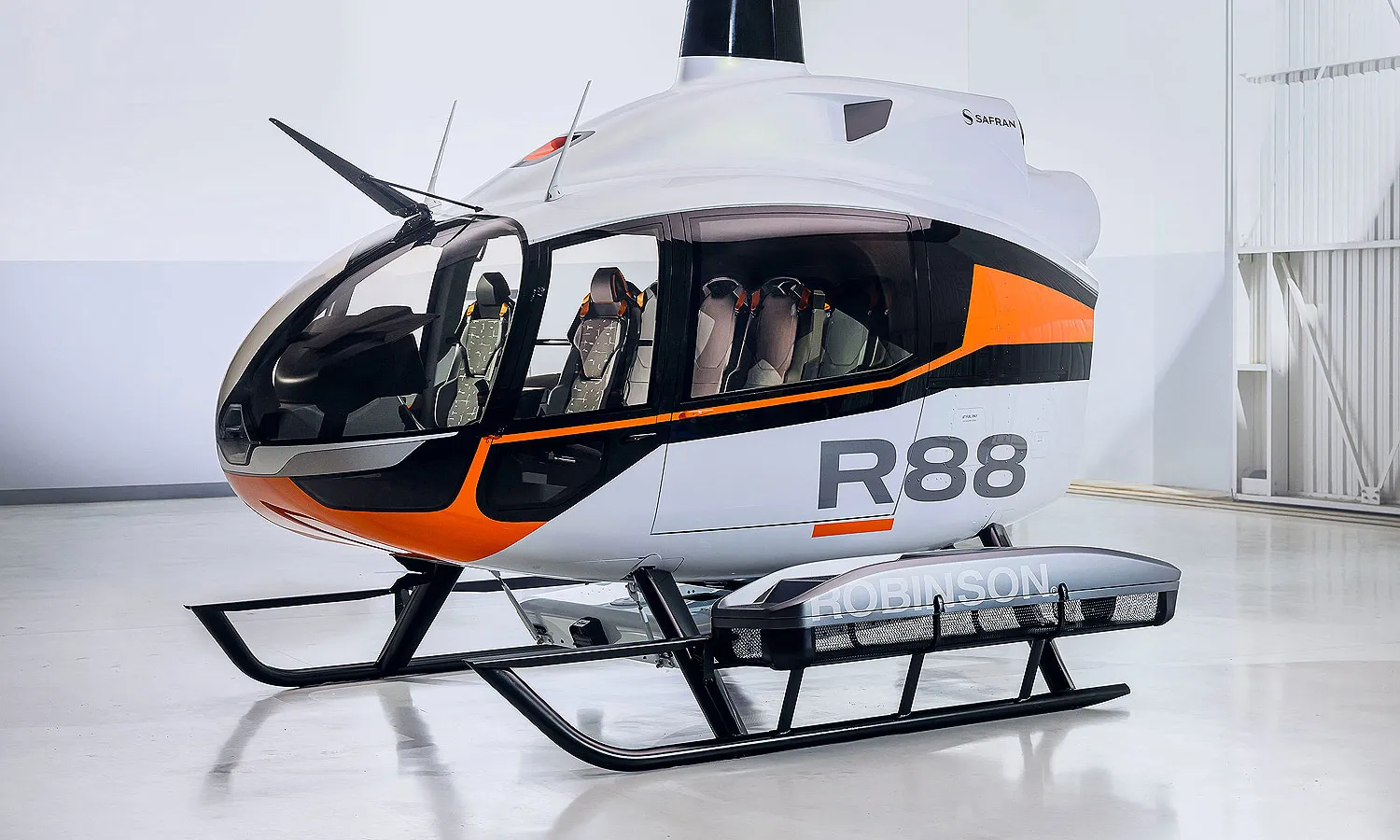
Robinson launches R88, its largest helicopter
U.S. helicopter manufacturer Robinson on Sunday unveiled its newest model, the R88, an eight-passenger aircraft that is its first launch in 15 years.
Powered by a 1,000-shp Arriel 2W turbine engine to be supplied by Safran, the R88 will be capable of flying up to 350 nm (650 km).
The new helicopter is the largest ever developed by the company founded in California in 1973 by former Bell and Hughes Helicopters employee Frank Robinson.
The aircraft will have two-bladed propellers and will be able to carry up to 2,880 pounds (1,306 kg). The cabin will have about 275 cubic feet (7,787 liters) of volume and a flat floor.

According to Robinson, the R88 will be highly versatile, with multiple seating options and the ability to take on roles such as an air ambulance or public safety.
The company chose the Garmin G500H TXi avionics suite with touchscreen displays, among other advanced features.
The R88 is priced at $3.3 million and includes the Serenity package, which provides support services for the Arriel 2W engine for five years or 2,000 flight hours.
“With the unveiling of the R88, we expect to disrupt the single-engine helicopter market, offering superior performance and capabilities at a competitive price,” said David Smith, president and CEO of Robinson Helicopter Company.

Competition with Bell and Airbus
Today, with a portfolio that includes the pioneering R22, a two-seater piston helicopter, the R44 (4 seats) and the R66, its first turbine model, Robinson was ranked in 2024 as the second largest manufacturer in terms of shipments of rotary-wing aircraft, behind only Airbus.
The R88, therefore, will put the Californian company in competition for customers with the European giant and also with the traditional Bell. One of the competitors targeted should be the H125, the best-selling helicopter on the market.
According to Smith, the R88 could add around 100 aircraft per year to the company’s annual production. Robinson, however, did not make exact predictions about the entry into service of the new helicopter, suggesting that this should occur by the end of this decade.
About the Author

Ricardo Meier
Creator of the website that started in 1996 as a magazine. He also writes on Brazilian websites AUTOO, MOTOO and MetrôCPTM.


