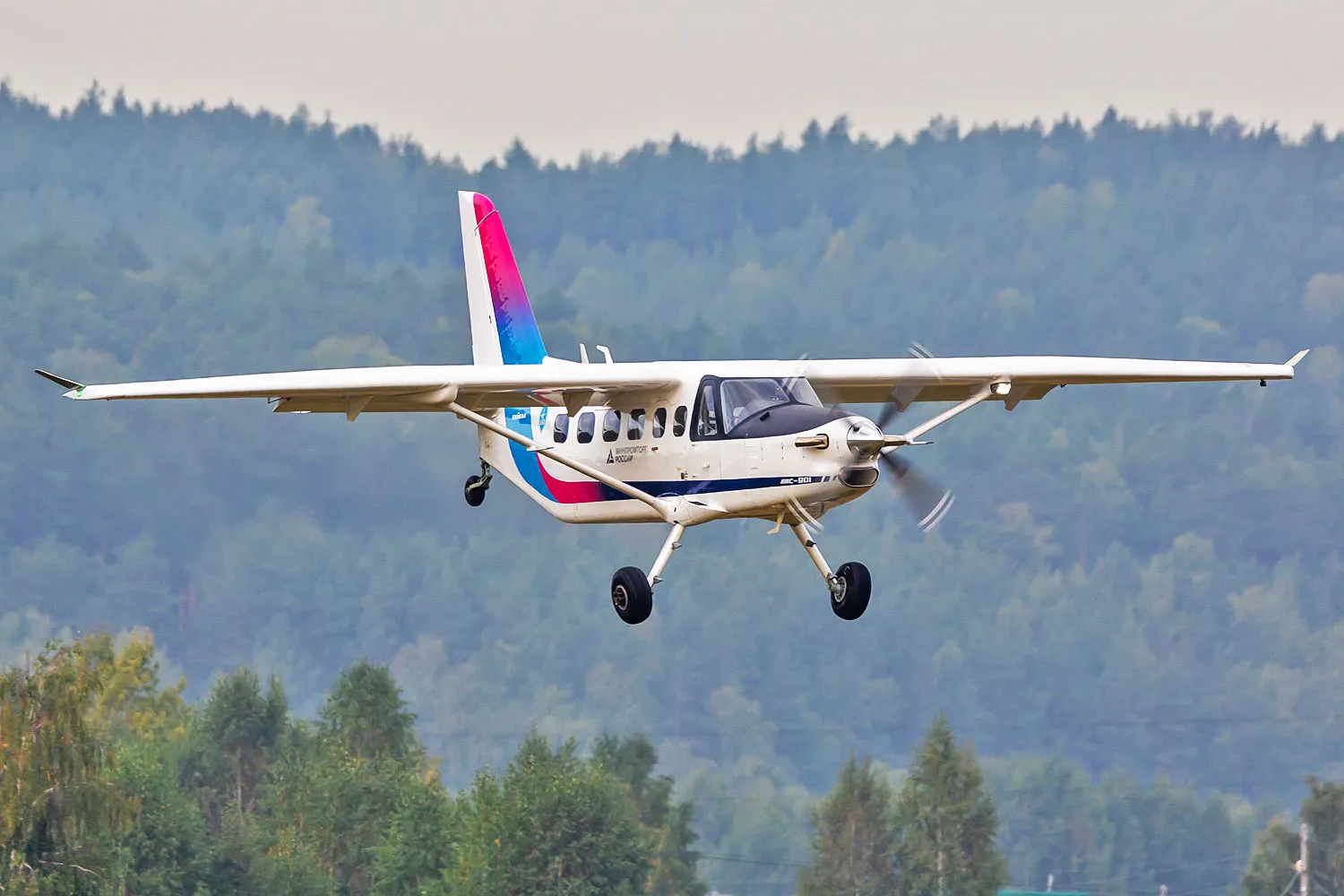
Russia announces termination of LMS-901 utility aircraft project, but later denies it
The development program for Baikal’s LMS-901 light utility aircraft has been going through ups and downs in recent days.
The Russian civilian aircraft was canceled, but later reconfirmed.
Russia’s Deputy Prime Minister, Yury Trutnev, announced that the LMS-901 would no longer be produced due to an unclear impasse.
At a meeting earlier this month of a committee of Far Western and Arctic states, Trutnev said that “as of today, this work has reached a dead end, which means that the Baikal aircraft is no longer expected.”
However, First Deputy Prime Minister Denis Manturov denied his colleague’s claim shortly after. “All final decisions have been made. This project will continue to evolve and will be implemented,” he said, according to the state news agency TASS.

The Russian Ministry of Industry and Trade also said that the project has undergone improvements that have proven its effectiveness and that the LMS-901 will therefore continue to be developed.
A replacement for the Antonov An-2
Developed by an engineering company that is a subsidiary of the Ural Works of Civil Aviation (UZGA), the LMS-901 was designed as a direct replacement for the Antonov An-2, the piston-engine biplane that has had thousands of units manufactured and has been used in several missions.
The prototype flew for the first time in January 2022 equipped with an H80 turboprop engine developed by GE Aviation at its subsidiary in the Czech Republic.

Trade sanctions against Russia, however, have forced the project to change in favor of the VK-800 engine, from Klimov.
The LMS-901 is 12.2 meters long, has a wingspan of 16.5 meters and a maximum takeoff weight of 4,800 kg. It can fly at up to 300 km/h at cruising speed and has an estimated range of 1,500 km with a payload of 2 tons. Like the An-2, the turboprop has high wings supported by struts and conventional fixed landing gear.
About the Author

Ricardo Meier
Creator of the website that started in 1996 as a magazine. He also writes on Brazilian websites AUTOO, MOTOO and MetrôCPTM.


