 Dubai Airshow
Russia claims MC-21 production in UAE is still possible, despite skepticism
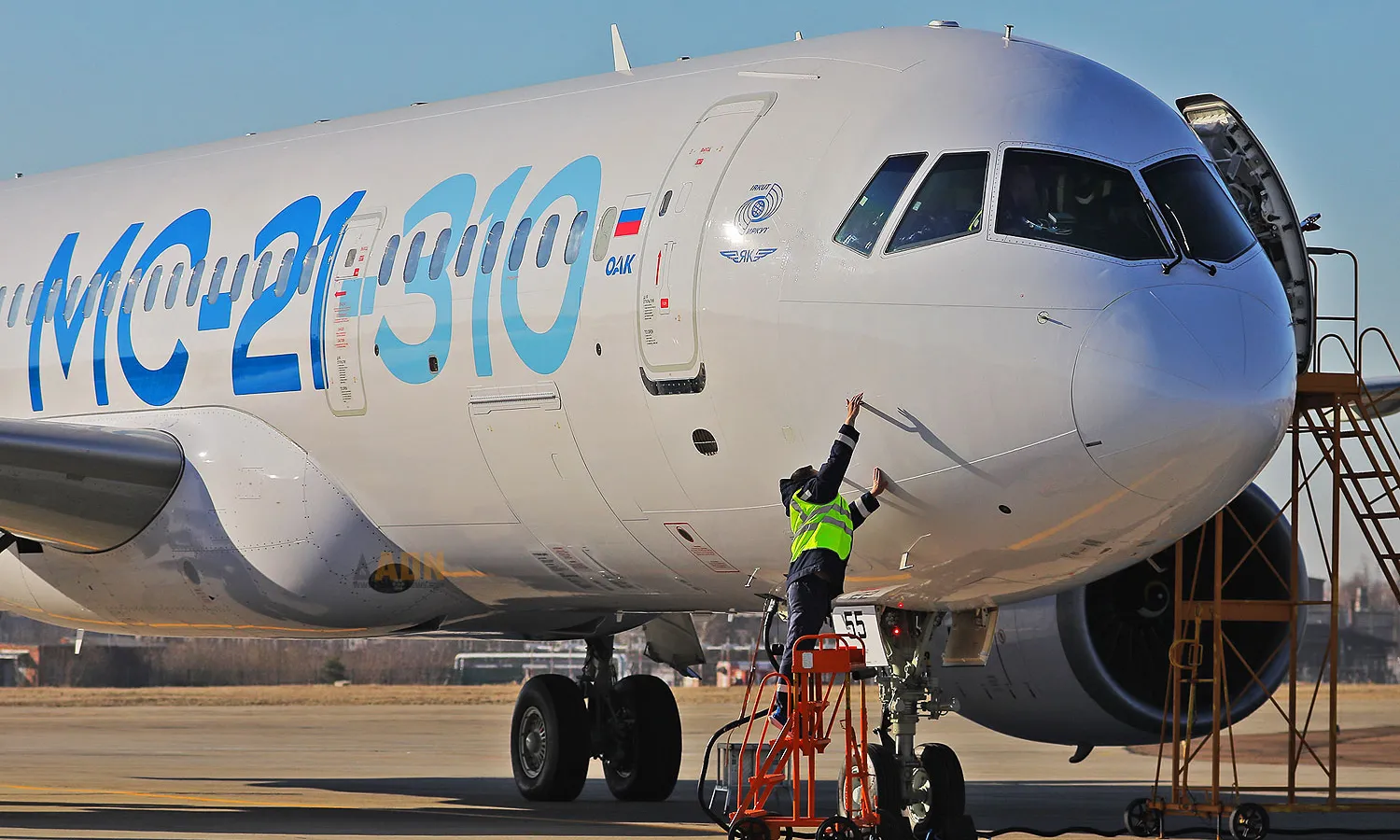
Russia continues to suggest it may someday establish partial production of the MC-21 airliner in the United Arab Emirates, a claim that runs counter to prevailing industry expectations.
Speaking to state news agency TASS during the Dubai Airshow 2025, Rostec CEO Sergey Chemezov said the proposal “has not been dropped,” although he acknowledged that it is not currently under discussion.
Chemezov reiterated that the immediate priority is supplying Russian carriers with domestically built aircraft before pursuing any foreign manufacturing venture.
The statement contrasts sharply with the reality faced by the MC-21 program. After Western sanctions cut access to critical imported components (including advanced composites, avionics and Pratt & Whitney PW1400G engines) the aircraft has undergone substantial redesign to integrate locally produced substitutes.

The so-called “import-substituted” MC-21, equipped with Russian PD-14 engines and domestically manufactured composite wings, only began flight testing in late October. Certification has already slipped to the end of 2026, a timeline most independent analysts view as optimistic given the scope of reengineering still underway.
Indian SJ-100
Export opportunities, such as a potential UAE assembly line, remain largely theoretical. With international markets wary of secondary sanctions and dependent on Western regulatory frameworks, Russia has so far been unable to secure foreign customers for the MC-21. The aircraft’s practical market today is limited to domestic airlines and a handful of politically aligned states such as Belarus.
These challenges mirror those of the SJ-100, the revised, fully “Russianized” version of the Superjet 100. The program is also replacing nearly all Western systems, including the Franco-Russian SaM146 engine, with a domestic powerplant still early in its testing phase.

In an effort to broaden the aircraft’s prospects, the Russian government recently signed a preliminary agreement with India to establish local SJ-100 assembly, a move aimed at reaching markets less exposed to Western export controls.
At the Dubai Airshow, Russia continues to project confidence. But between sanctions, technical setbacks and slow certification progress, the country’s commercial aircraft programs remain far from achieving the global reach suggested by their official rhetoric.
About the Author

Ricardo Meier
Creator of the website that started in 1996 as a magazine. He also writes on Brazilian websites AUTOO, MOTOO and MetrôCPTM.


