 Defense
Russia targets 2026 first flight for Su-75 after years of delays
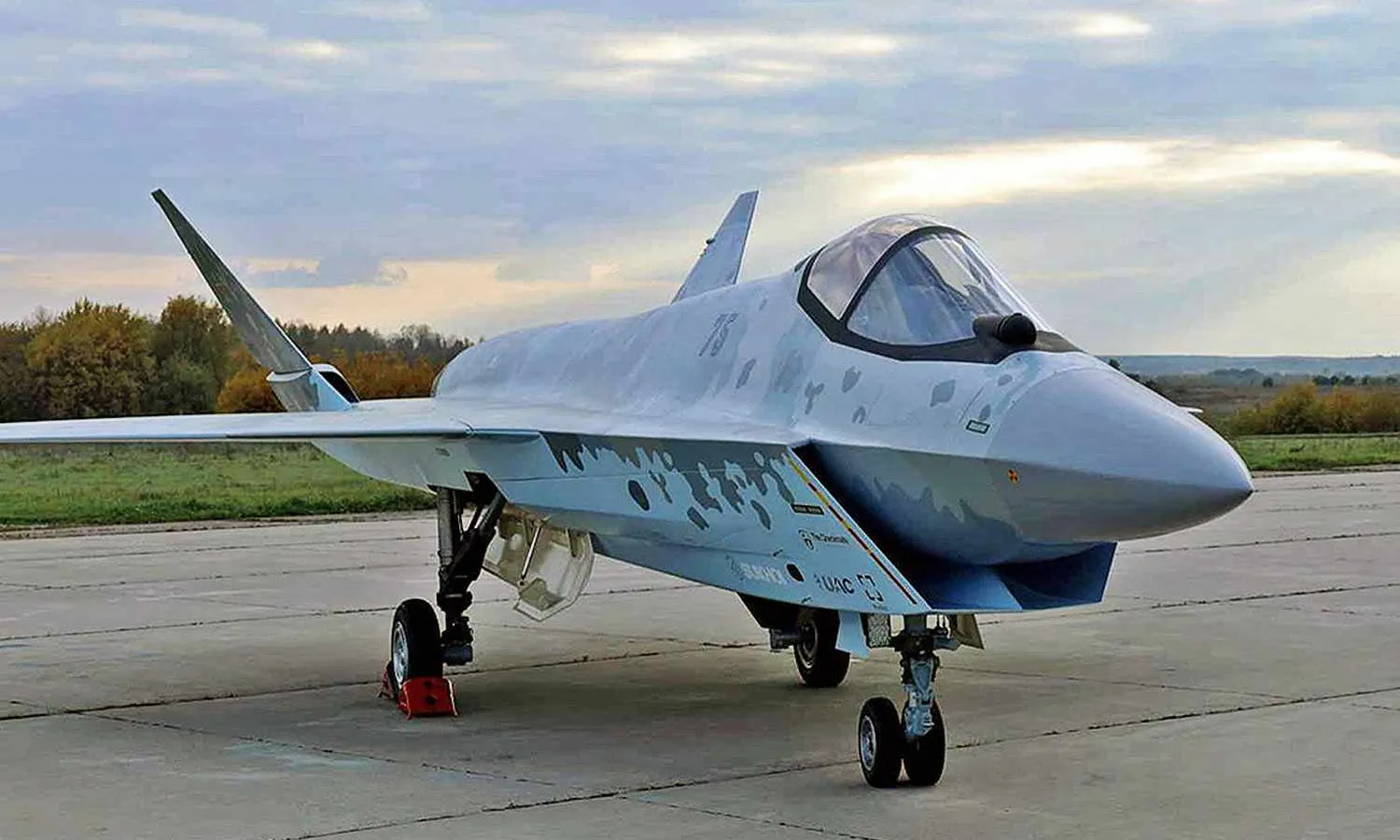
Russia is planning the first flight of the Su-75 “Checkmate” light stealth fighter in 2026, marking the latest revision to a program that has faced repeated delays since its public unveiling more than four years ago.
The Su-75 was first revealed in 2021 as a full-scale mock-up and presented as a lightweight, single-engine combat aircraft intended to complement the heavier Su-57 and eventually replace ageing MiG-29 variants. At the time, Russian officials projected an initial flight as early as 2023, but the timeline was subsequently pushed back to 2024, then 2025, and now to 2026.
Since its debut, progress on the program has been limited, with no publicly confirmed flight-testing milestones and no announced domestic or export orders. Development has taken place amid funding constraints, shifting industrial priorities and the impact of international sanctions, which have restricted access to certain components and production resources. These factors have coincided with increased emphasis on sustaining output of existing combat aircraft already in service.
The Su-75 is intended to fill a gap in Russia’s combat aviation portfolio by reintroducing a modern lightweight fighter, a category absent from new domestic development since the end of the MiG-29 production era. In operational terms, the aircraft is envisioned as a lower-cost multirole platform for air-to-air and air-to-ground missions, designed to operate alongside heavier twin-engine fighters rather than replace them.
From the outset, the program has been framed with a strong export focus, targeting air forces seeking a more affordable aircraft with reduced radar signature and modern sensors. Russian officials have repeatedly linked the project’s future production scale to foreign interest, suggesting that the Su-75’s viability depends as much on export commitments as on domestic requirements.

As of early 2026, the Su-75 remains in the pre-flight development phase. Whether the aircraft will finally transition from concept to flying prototype this year is expected to be a key test of Russia’s ability to advance new combat aircraft programs under ongoing industrial and geopolitical pressure.
About the Author

Ricardo Meier
Creator of the website that started in 1996 as a magazine. He also writes on Brazilian websites AUTOO, MOTOO and MetrôCPTM.