 Industry
Saab plans 2027 flight of fighter-sized unmanned demonstrator
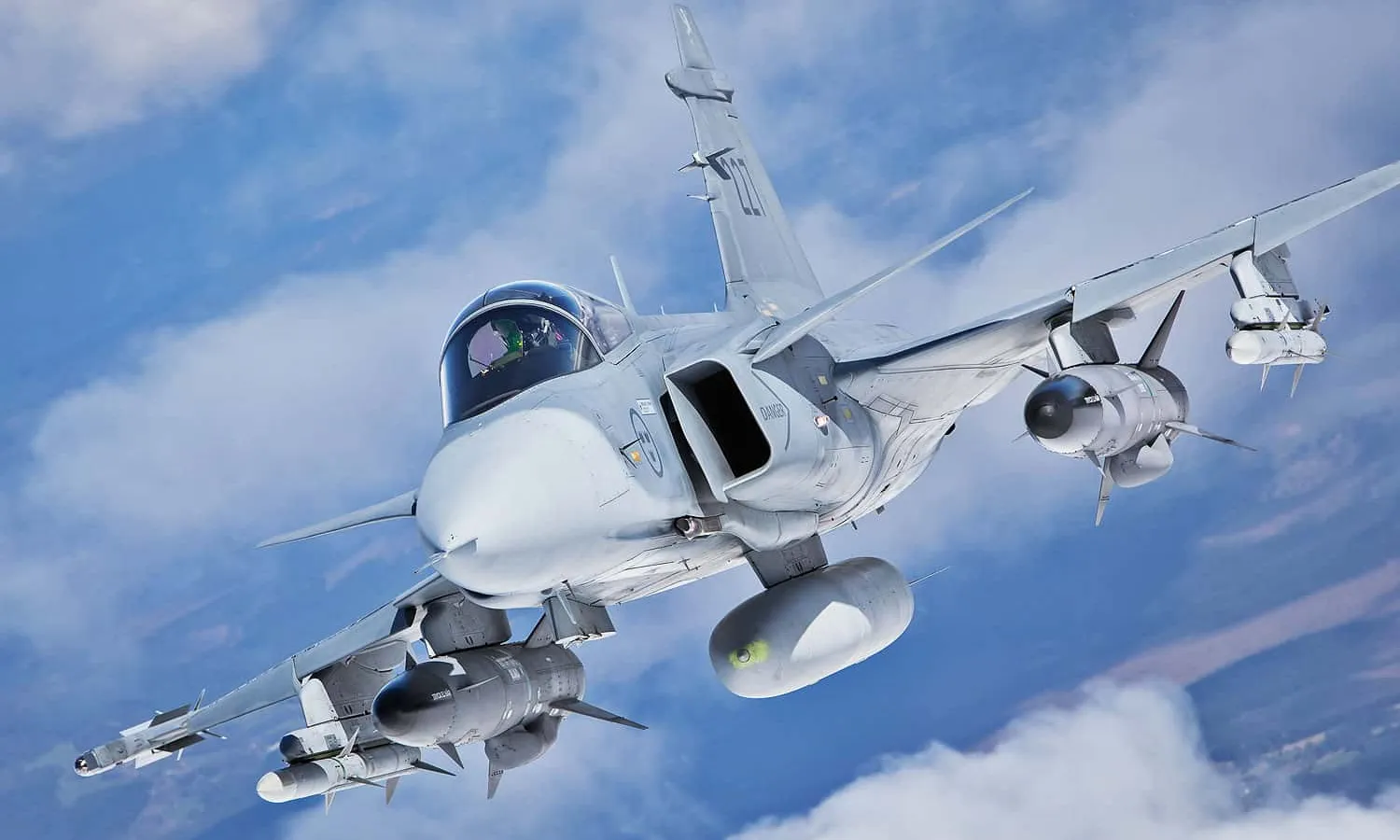
Saab plans to conduct the first flight of a fighter-sized unmanned demonstrator in 2027 as part of a Swedish government-funded program aimed at defining the country’s future air combat system. The effort forms the second phase of the Future Fighter System initiative and marks a shift from purely conceptual work to practical technology validation.
The demonstrator is part of a program launched in 2024 and scheduled to run through 2029. Its purpose is to provide technical input for a government decision, due by 2030, on what will replace the Gripen fighter. According to Saab, three options are under consideration: developing a new fighter independently, pursuing international cooperation, or acquiring an off-the-shelf foreign aircraft.
Company executives say current work spans dozens of parallel projects, covering areas such as advanced autonomy for crewed and uncrewed systems, artificial intelligence, low observability, electronic warfare, rapid prototyping and additive manufacturing. Some of these technologies will be evaluated on the ground before moving to flight testing.
A key focus is what Saab describes as “robust low observability”, intended to deliver stealth characteristics compatible with the Swedish Air Force’s operational concept. This includes the ability to operate from dispersed bases and improvised runways, such as highways, without reliance on specialized infrastructure or complex maintenance processes.
The flying demonstrator is also expected to use Saab’s “split core” software architecture, already employed on the Gripen E. The approach separates flight-critical functions from mission systems, allowing more frequent updates to tactical software without significantly affecting aircraft availability or certification requirements.

Saab says later phases of the government program could include demonstrators with supersonic capability. However, details such as propulsion, final configuration and a potential in-service timeline for an operational fighter have yet to be defined.
Alongside the future fighter work, Saab is advancing studies related to collaborative combat aircraft (CCA) for both military and civil applications. Developments in other European fighter programs are being closely monitored in Stockholm, as changes elsewhere could influence Sweden’s strategic choices.

Sweden’s standalone effort comes amid two major European collaborative programs: the Global Combat Air Programme (GCAP), involving the UK, Italy and Japan, and the Future Combat Air System (FCAS), led by France, Germany and Spain. The latter faces uncertainty due to disagreements over industrial leadership, particularly involving Dassault Aviation.
Sweden previously explored closer cooperation with the UK during the early phase that led to the creation of GCAP but ultimately stepped away from a formal partnership. Separately, Saab has signed an agreement with Airbus to explore collaborative combat aircraft technologies.
About the Author

Ricardo Meier
Creator of the website that started in 1996 as a magazine. He also writes on Brazilian websites AUTOO, MOTOO and MetrôCPTM.