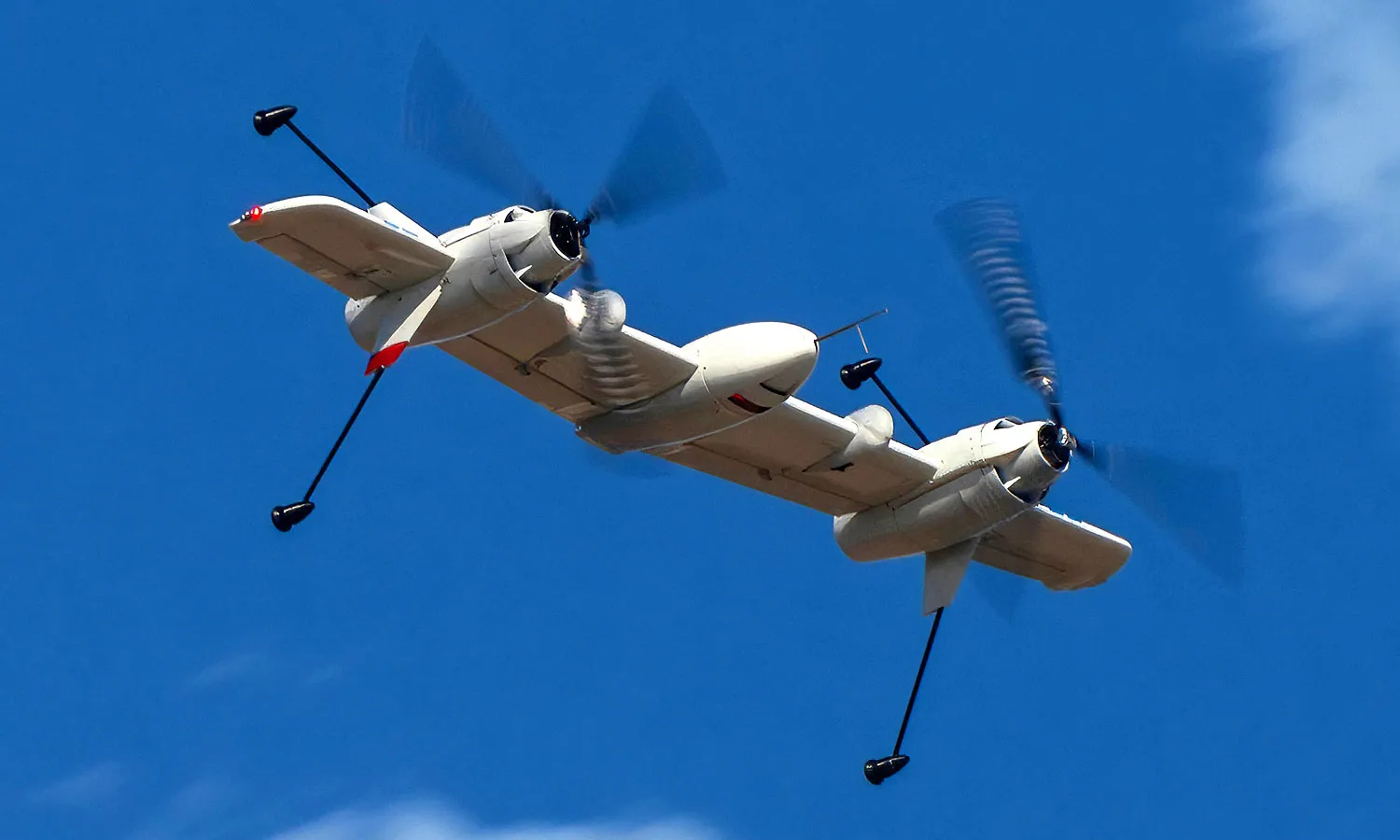
Sikorsky successfully tests VTOL aircraft with "Rotor Blown Wing" configuration
Sikorsky revealed on Monday that it has successfully completed more than 40 takeoff and landing operations with a prototype “Rotor Blown Wing” aircraft.
The flights were conducted in January with an Unmanned Aerial System (UAS) with a 10.3-foot (3.14-meter) wingspan and two hybrid-electric engines.
The aircraft consists of a non-swept wing, a small fuselage and two engine mounts with large-diameter propellers.
Sikorsky’s UAS operates from the ground in a vertical position, supported by four fixed legs.

It takes off and lands in this configuration, but in cruise flight, the aircraft can rotate to a horizontal position and thus achieve greater speed.
The position of the engines explains the term “Rotor Blown Wing,” as they increase lift by directing the accelerated airflow around the wings.
According to the company, “the prototype has demonstrated operational stability and maneuverability across all flight regimes.”
Varied missions and crewed variants
During the test period, the small unmanned aircraft made 30 transitions between “helicopter” and “airplane” modes and reached 86 knots of cruise speed.

“Combining helicopter and airplane flight characteristics onto a flying wing reflects Sikorsky’s drive to innovate next-generation VTOL UAS aircraft that can fly faster and farther than traditional helicopters,” said Sikorsky Vice President and General Manager Rich Benton.
“Our rotor blown wing platform is a prime example of how we are leveraging the breadth of our 102-year aviation heritage to develop new designs that meet the emerging missions of commercial and military operators.”
Sikorsky cited search and rescue, fire monitoring, humanitarian response, and military missions such as long-range intelligence, surveillance, and reconnaissance as potential applications for the aircraft.
Although initially conceived as an unmanned product, the model could give rise to crewed variants.

Flight control, however, will be performed by the MATRIX autonomous flight system, the manufacturer explains.
In the promotional video, Sikorsky shows the UAS taking off from a U.S. Navy ship equipped with reconnaissance sensors.
There are also scenes of medical deliveries and an armed version for the Army.
https://www.youtube.com/watch?v=cDnN1BcUDBU
About the Author

Ricardo Meier
Creator of the website that started in 1996 as a magazine. He also writes on Brazilian websites AUTOO, MOTOO and MetrôCPTM.


