 Defense
South Korea sets KF-21 price and plans first deliveries from 2026
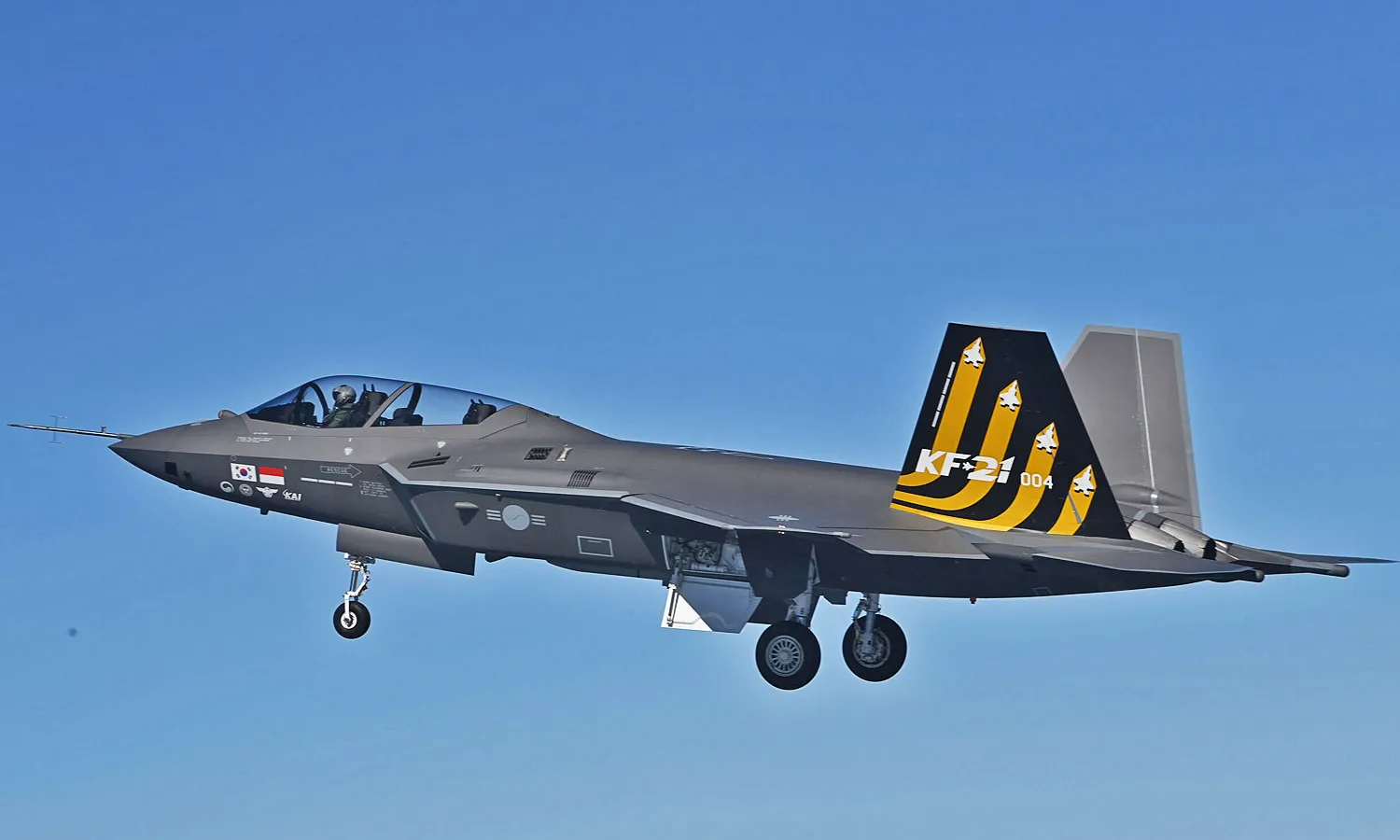
South Korea is moving toward the first deliveries of its indigenous KF-21 Boramae fighter to the Republic of Korea Air Force (ROKAF) in 2026, as the program enters its transition from development to operational service and clearer unit pricing emerges.
South Korean authorities have disclosed indicative unit costs for the aircraft, placing the Block I air-superiority variant at approximately $83 million, while the more capable Block II multirole version is priced at around $112 million. The figures reflect differences in mission systems and weapons integration rather than changes to the basic airframe.
Block I aircraft are optimized for air-to-air and air-defense roles and are planned in a batch of around 40 jets for ROKAF service. Block II, expected to follow later in the decade, will expand the KF-21’s mission set to full air-to-ground operations, driving the higher unit cost through additional strike systems and munitions integration.
The first production-standard KF-21s are scheduled for delivery after the completion of acceptance testing, marking the initial induction of a domestically developed combat aircraft largely produced by South Korean industry under the leadership of Korea Aerospace Industries.
The program is intended to replace aging F-4 Phantom II and F-5 Tiger II fighters while reducing South Korea’s reliance on foreign combat aircraft. Following the maiden flight of the first prototype in 2022, the test campaign progressed through multiple flying prototypes, validating flight performance, avionics, and mission systems. Serial production began in 2024, with final assembly of the first operational aircraft completed in 2025.

Classified as a 4.5-generation fighter, the KF-21 incorporates a domestically developed active electronically scanned array (AESA) radar, mission computer, electronic warfare systems, and fly-by-wire flight controls. South Korean officials describe the aircraft as a complementary platform rather than a replacement for fifth-generation fighters, a positioning reflected in both its capabilities and pricing.
Internationally, the KF-21 is being closely watched as a potential export platform. Sustained global demand for 4.5-generation fighters, particularly among air forces seeking modern capabilities without the cost and political constraints of fifth-generation programs, underpins South Korea’s export ambitions for the Boramae as deliveries begin from 2026.
About the Author

Ricardo Meier
Creator of the website that started in 1996 as a magazine. He also writes on Brazilian websites AUTOO, MOTOO and MetrôCPTM.