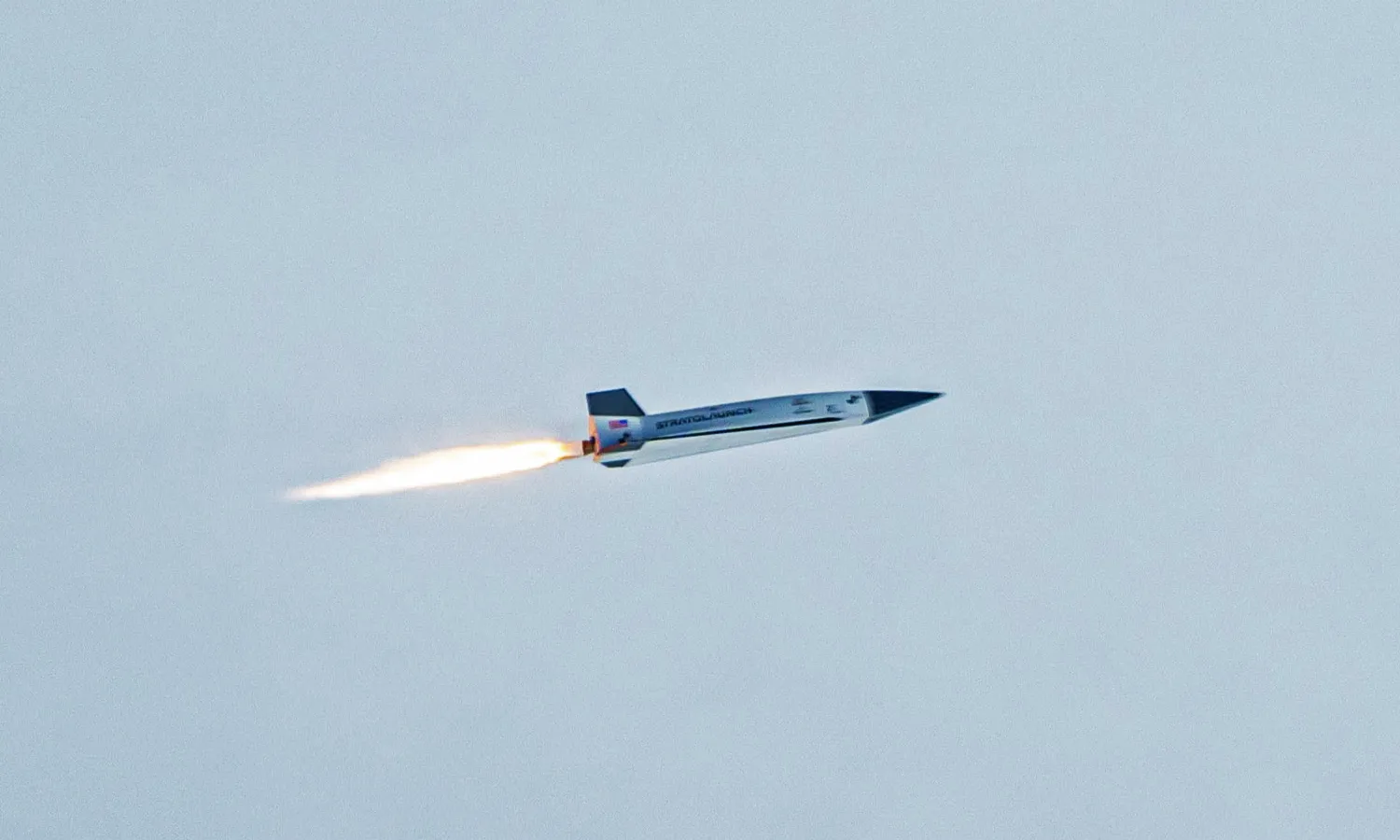
Stratolaunch reveals first hypersonic flights with Talon-A vehicle
Stratolaunch, a US company specializing in air launch systems, confirmed the successful completion of two hypersonic flights with the Talon-A2 (TA-2) reusable vehicle, carried out in December and March.
The missions exceeded the speed of Mach 5, something not seen in the US since the era of the legendary X-15, which ended in 1968.
On both flights, the vehicle was launched over the Pacific Ocean by the gigantic Roc aircraft, considered the largest in the world in operation, with a wingspan of 117 meters and equipped with six engines originally designed for the Boeing 747.
The Talon-A is a rocket-powered unmanned aircraft designed to be reusable. It lands autonomously at Vandenberg Space Force Base, in California, after completing its supersonic flights.
According to Zachary Krevor, CEO of Stratolaunch, the data collected during the flights confirms the robustness of the project: “We are firmly on the path to making hypersonic testing a reality.”

The flights are part of the MACH-TB (Multi-Service Advanced Capability Hypersonic Test Bed) program, an initiative of the Test Resource Management Center (TRMC) in partnership with the company Leidos.
The goal is to accelerate the development of hypersonic technologies in the United States, using reusable vehicles as a test bed to reduce time and costs.
Boeing 747 “Spirit of Mojave
Pentagon sources say the results of the Talon-A tests should allow the intervals between hypersonic missions to be reduced “from months to weeks.”
Stratolaunch has already completed four flights with Talon-A vehicles, two sub-hypersonic with the TA-1, a non-reusable variant, and two hypersonic with the TA-2. A third reusable vehicle, the Talon-A3, is in production.

The program is funded by private investors and research contracts from the U.S. Air Force Research Laboratory (AFRL). Each Talon-A is powered by a Hadley engine developed by Colorado-based Ursa Major.
In addition to the Roc, Stratolaunch is working on developing a second launch aircraft, the *Spirit of Mojave*, based on a modified Boeing 747-400 that flew with the bankrupt Virgin Orbit.
About the Author

Ricardo Meier
Creator of the website that started in 1996 as a magazine. He also writes on Brazilian websites AUTOO, MOTOO and MetrôCPTM.


