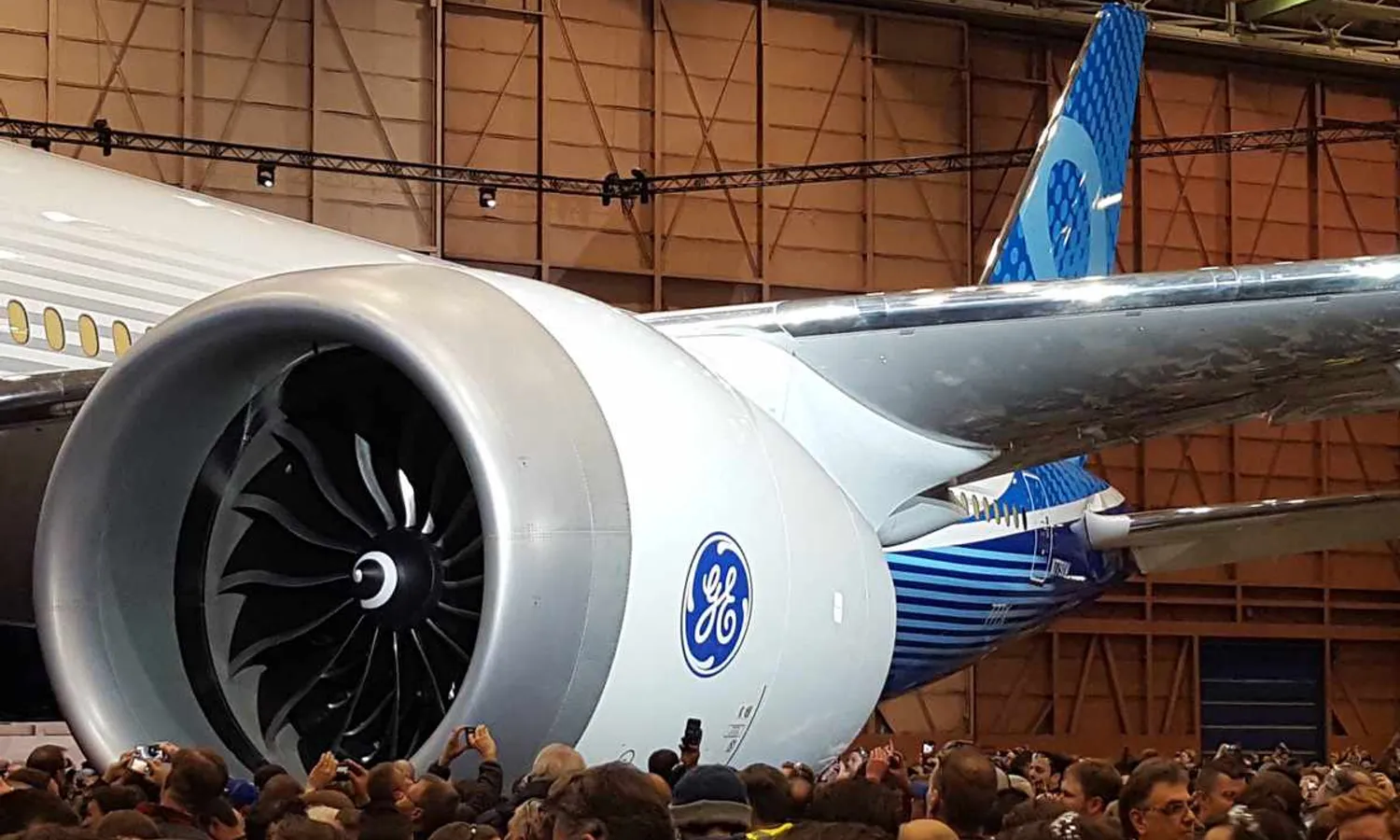
The world's most powerful commercial engine is already in production for the Boeing 777X
The Boeing 777X is expected to make its world debut in 2026, and with it the most powerful jet engine commercial aviation has ever seen, the GE9X.
Made by GE Aerospace, the GE9X will arrive as a new family of large turbofan engines with higher static thrust than the current GE90, whose most powerful version is the 115B.
For the 777X, which will be offered in the 777–8, 777–8 Freighter and 777–9 variants, the GE9X will have a certified thrust of 105,000 pounds, but it can reach up to 134,000 pounds.

The power far surpasses the GE90-115B’s 115,000-pound maximum, making the 777X the most powerful commercial aircraft in the world.
It’s no wonder that Boeing describes its upcoming aircraft as “the world’s largest and most efficient twin-engine jet.” With a pair of GE9X engines, the 777X can reach an impressive 268,000 pounds of thrust.
The good news is that GE has already started production in recent weeks.

Category 5 Mini-Hurricane
The GE9X is so large that its hull is wider than the width of a Boeing 737 fuselage. According to the manufacturer, the wake left by the GE9X produces a vortex so powerful that GE describes it as a Category 5 mini-hurricane.
The GE9X fan is 3.4 meters in diameter and has a bypass ratio of 10:1 with an overall pressure ratio of 60:1, figures higher than those of the GE90.
Despite its size, the GE9X has 16 blades in fourth-generation composites, fewer than those of the GE90, which has 22 blades. In addition, the new engine produces 55% less NOx than the limits of international regulations.
It also emits 50% less NOx than similar engines, thanks to the smaller number of blades, which increases airflow and reduces drag, thus ensuring lower consumption, around 5% compared to competitors and 10% compared to the GE90.

According to GE, airlines can stop consuming 3,000 tons of fuel per year and cut 9,500 tons of CO² emissions. This would be like taking 2,060 cars off the streets every year.
With capacity for up to 426 passengers in the 777-9 version and a range of 16,190 km in the 777-8 version, the Boeing 777X promises great efficiency in the aviation market, with sales already being closed in large volumes.
About the Author