Defense
U.S. warns Canada over fighter choice as F-35 deal comes under review
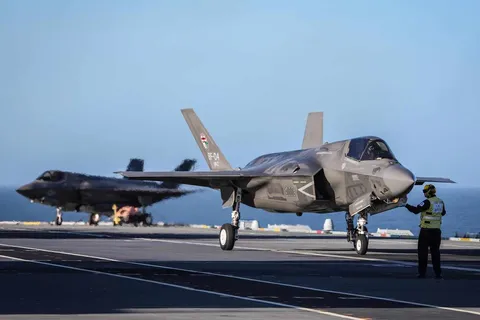
The United States has stepped up pressure on Canada to proceed with its planned acquisition of the Lockheed Martin F-35, warning that a decision to select another fighter could affect the future structure of North American air defense cooperation.
Canada signed a CAD19 billion agreement in January 2023 to acquire 88 F-35A fighters to replace the Royal Canadian Air Force’s aging CF-18 fleet, with deliveries planned in four tranches through 2032. Sixteen aircraft have already been paid for and are expected to be delivered as scheduled, but the new government of Prime Minister Mark Carney has ordered a review of whether to proceed with the remaining 72 jets.
The review has drawn a sharp response from Washington. U.S. Ambassador to Canada Pete Hoekstra said publicly that failing to complete the F-35 purchase would have “significant consequences” for NORAD, the binational command responsible for the aerospace defence of North America.
NORAD relies on closely integrated fighter fleets, sensors and command systems to ensure that the nearest available aircraft (whether Canadian or American) can respond quickly to airspace incursions. U.S. officials argue that interoperability is a central reason for Canada’s selection of the F-35, which is already operated by the U.S. Air Force and several NATO allies.
Hoekstra suggested that if Canada does not field a fleet compatible with U.S. systems, American forces would need to assume a greater share of air policing missions over Canadian territory. He also indicated that choosing a different fighter, such as Saab’s Gripen, would require a reassessment of how NORAD operates.

Saab package includes Gripen E/F fighters and GlobalEye AEW aircraft
The comments have raised concerns in Canada, where defense analysts and former officials have described them as political pressure rather than a technical assessment. Ottawa has repeatedly stated that it remains committed to NORAD and has been negotiating with Washington on modernization efforts, including new radar networks and missile defence elements.
The F-35 offers deep integration with U.S. and allied forces, advanced sensor fusion and stealth capabilities, but ties Canada closely to U.S.-controlled supply chains, software updates and sustainment systems. Critics within Canada have pointed to the risk of dependence, particularly given recent political tensions between Ottawa and Washington.
Saab, meanwhile, has renewed its offer of 72 Gripen E/F fighters, coupled with GlobalEye airborne early warning aircraft and extensive local industrial participation. The Swedish proposal emphasizes domestic production, technology transfer and job creation, and has been pitched as an alternative that preserves Canadian sovereignty over sustainment and upgrades. However, the Gripen does not match the F-35’s fifth-generation characteristics and is not operated by the U.S. military.
Within the RCAF, senior officers have noticed the importance of maintaining parity with potential adversaries. Canada’s air force leadership has noted that both China and Russia are deploying fifth-generation fighters and advanced missiles, reinforcing arguments in favor of the F-35 from an operational standpoint.

About the Author

Ricardo Meier
Creator of the website that started in 1996 as a magazine. He also writes on Brazilian websites AUTOO, MOTOO and MetrôCPTM.