Defense
US surges airpower to Middle East as tensions with Iran escalate
The United States has moved a large package of air and naval assets toward the Middle East in recent days, in what analysts describe as the most significant surge of U.S. air power in the region since the 2003 Iraq war.
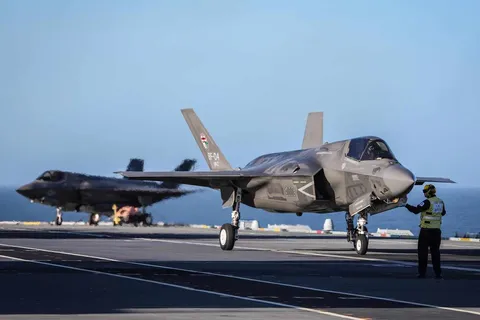
Open-source flight tracking and defense officials indicate that more than 120 aircraft have redeployed from bases in the continental United States and Europe. The deployments include Boeing E-3 Sentry Airborne Warning and Control System (AWACS) aircraft, Lockheed Martin F-22 Raptor air superiority fighters and F-35 Lightning II stealth strike fighters, as well as Boeing F-15E Strike Eagle and Lockheed Martin F-16 Fighting Falcon jets.
The movement has been supported by strategic airlifters and aerial refueling tankers, indicating the scale and endurance of the operation. The presence of E-3 Sentry aircraft provides long-range airborne surveillance and battle management, a key enabler for complex air campaigns.

F-22 Raptors and F-35 Lightning IIs previously escorted Northrop Grumman B-2 Spirit stealth bombers during U.S. strikes on Iranian nuclear sites in June 2025. Analysts say any renewed movement of B-2 aircraft would be closely watched as a potential indicator of long-range strike preparations.
Several weeks before the latest surge, U.S. Air Force F-15E Strike Eagles arrived in the region. U.S. Central Command described the deployment at the time as enhancing combat readiness.
Attention has also focused on Diego Garcia, the joint U.K.-U.S. military facility in the Indian Ocean. The remote base is capable of hosting long-range strategic bombers, including the B-2 Spirit, and has served as a launch point for previous U.S. air campaigns in the Middle East.

In parallel with the air deployments, the U.S. Navy is reinforcing its carrier presence. The nuclear-powered aircraft carrier USS Gerald R. Ford (CVN 78), the lead ship of its class, is transiting from the Atlantic toward the Mediterranean and is expected to move onward to the Middle East. It will join the USS Abraham Lincoln (CVN 72) carrier strike group, which satellite imagery shows operating in the Arabian Sea.
Carrier air wings embarked on these vessels typically include Boeing F/A-18E/F Super Hornet strike fighters, EA-18G Growler electronic attack aircraft, E-2D Advanced Hawkeye airborne early warning aircraft and MH-60R/S Seahawk helicopters.
The U.S. Navy also maintains guided-missile destroyers in the region equipped with the Aegis combat system and capable of launching Raytheon Tomahawk land-attack cruise missiles. These surface combatants provide ballistic missile defense and long-range strike capability.
Iran has responded with military signaling of its own. Tehran has begun joint naval drills with Russia in the Sea of Oman and northern Indian Ocean and issued a Notice to Airmen for rocket launches over southern Iran. Iranian authorities have also temporarily restricted navigation in parts of the Strait of Hormuz during live-fire exercises.

Satellite imagery published this week indicates that Iran has reinforced and concealed portions of sensitive military and nuclear infrastructure, including tunnel entrances and missile facilities previously struck during earlier hostilities.
Analysts say the current U.S. posture mirrors preparatory steps typically taken ahead of potential strike operations: forward positioning of fighter aircraft, deployment of airborne command-and-control platforms and the concentration of carrier-based airpower within range of Iranian territory.
Whether the buildup culminates in direct military action remains unclear. However, the scale and composition of the aircraft now in theater — from F-22 and F-35 fighters to B-2 bombers and E-3 command aircraft — point to a force package designed for sustained, high-intensity air operations rather than routine rotational deployments.

About the Author

Ricardo Meier
Creator of the website that started in 1996 as a magazine. He also writes on Brazilian websites AUTOO, MOTOO and MetrôCPTM.