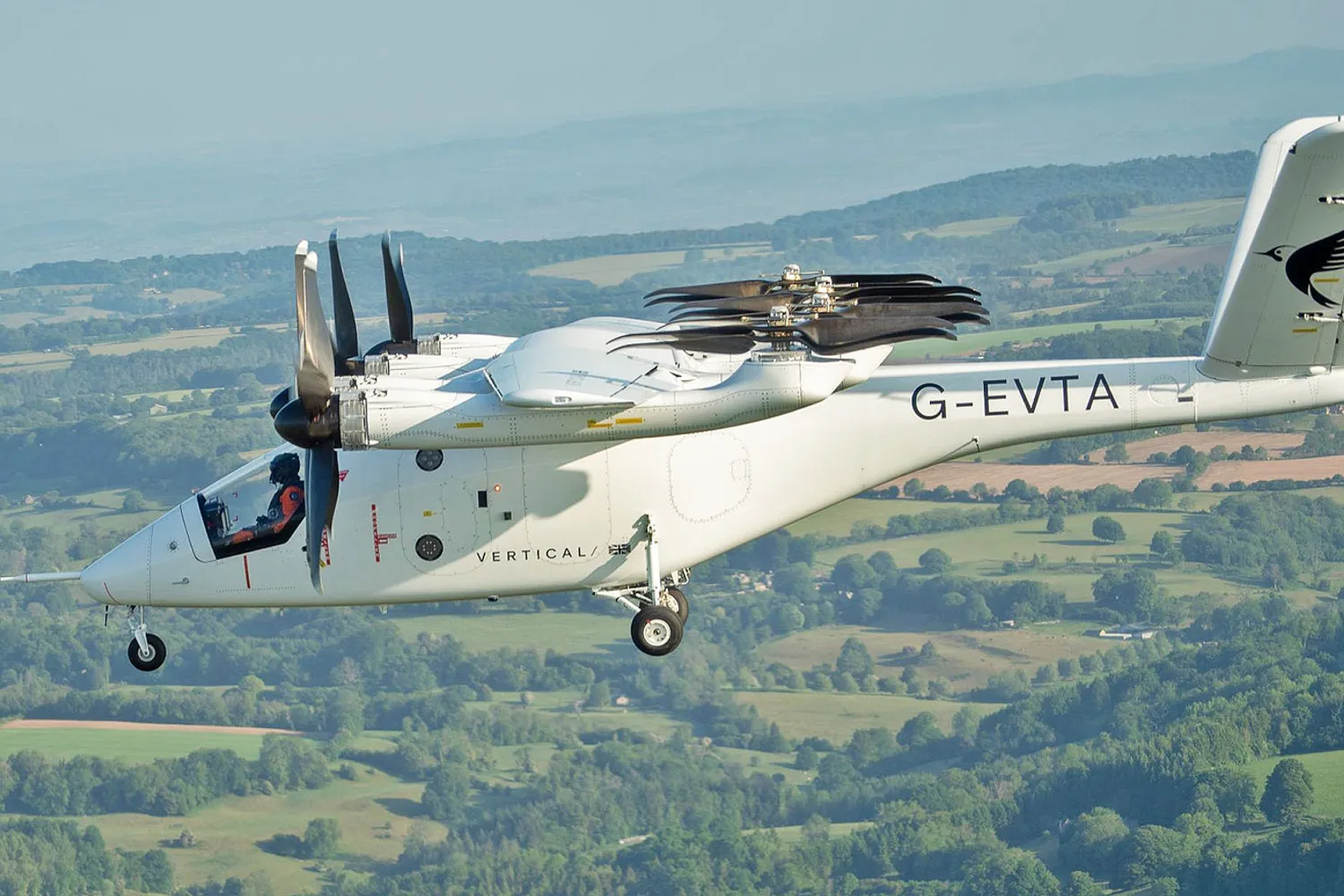
Vertical Aerospace completes first wingborne flight of a manned eVTOL in open airspace
British startup Vertical Aerospace has set a milestone in electric aviation by completing the first wingborne flight of a manned eVTOL.
The feat was achieved on May 22, with the VX4 prototype taking off from Cotswold Airport in the UK, entering open airspace in Europe for the first time.
Flying under Simon Davies, the company’s head of test, the VX4 completed a full takeoff, cruise and landing flight like a conventional aircraft, using its wings to generate lift.
This is a different mode of operation to vertical operations, in which thrust comes from the rotors pointing upwards. The flight was cleared by the UK Civil Aviation Authority (CAA) after a technical and safety review.

On the road to certification
The new flight marks Phase 3 of Vertical’s test campaign, which has already completed the tethered flight and thrustborne (low-speed vertical flight) stages.
The next stage will be the transition flight, which is expected to occur in 2025 and will demonstrate the VX4’s ability to switch between vertical and horizontal flight — an essential operation for commercial eVTOL use.
During the May 22 flight, VX4 reached speeds close to 240 km/h (150 mph) and flew at an altitude of about 2,000 feet. More than 30,000 flight parameters were collected, according to Vertical Aerospace, which confirmed the “exceptional performance in control, stability and energy consumption.”

“The VX4 was not only safe — it was an absolute pleasure to fly. Smooth, responsive and quiet,” Davies said after the flight.
The VX4 prototype was developed under CAA design approval, a prerequisite for type certification and commercial operations. The British agency is working together with EASA, its European counterpart, to simultaneously validate the model.
Urban and regional air mobility operations
In addition, the company has released data on its pre-flight systems testing, including:
– 7.2 million fatigue cycles on the propellers;
– 15.2 m drop test of the battery pack;
– Full thermal propagation test on the battery sub-pack;
– More than 3,000 hours of flight control systems testing.
The VX4 will have capacity for up to four passengers plus pilot, with a focus on urban and regional air mobility operations.
About the Author

Ricardo Meier
Creator of the website that started in 1996 as a magazine. He also writes on Brazilian websites AUTOO, MOTOO and MetrôCPTM.


